Examples of Intentions to Help You Live a More Meaningful Life
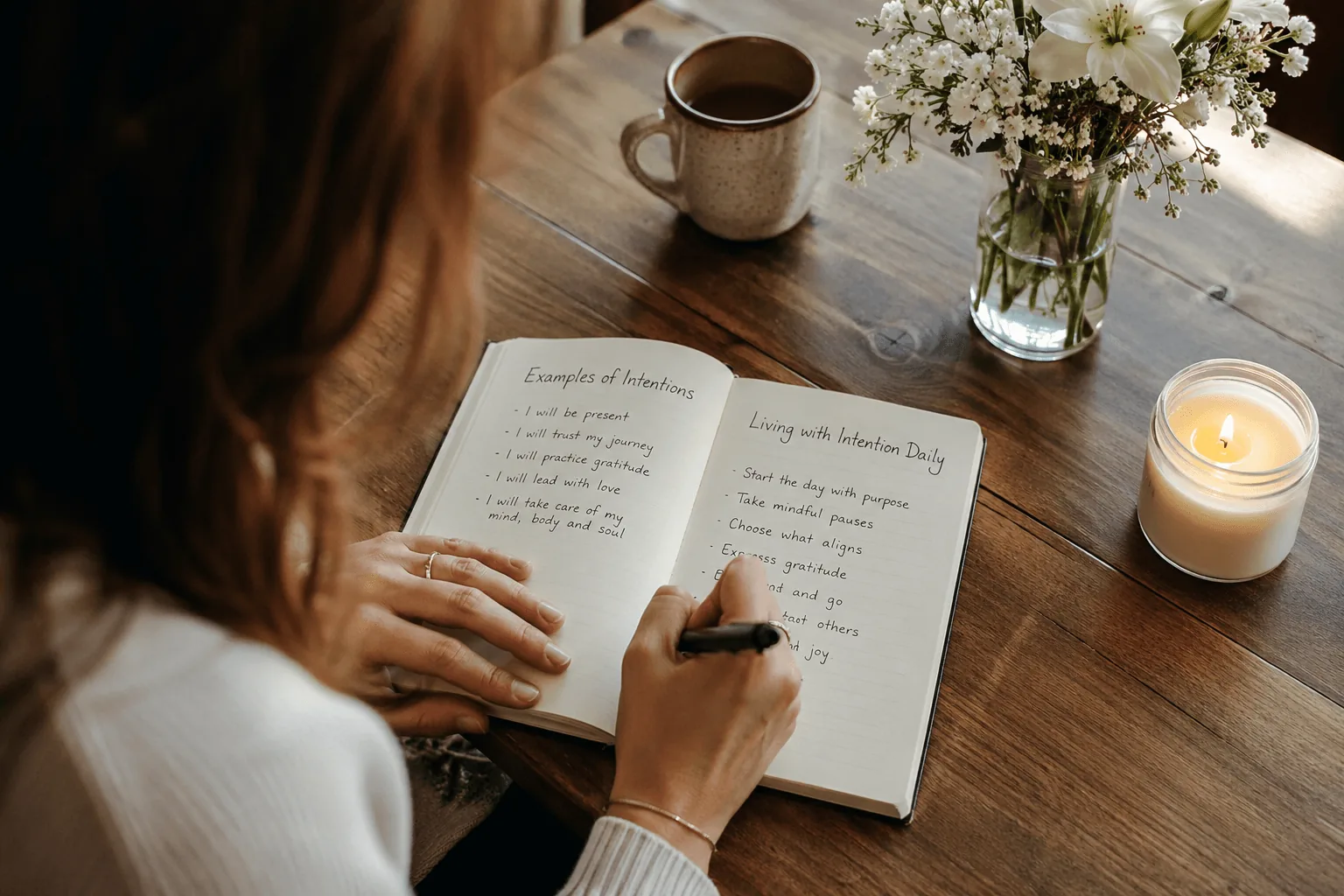
Examples of Intentions That Help You Live With Intention and Create a More Meaningful Life
Setting clear examples of intentions is one of the most powerful steps you can take toward a more purposeful life. Yet most people confuse intentions with goals — and that confusion costs them clarity, direction, and peace of mind. Living with intention means choosing how you want to show up in the world, not just what you want to achieve. It means bringing deliberate awareness to your thoughts, actions, and relationships every single day.
The difference is meaningful. And it starts with understanding what an intention actually is.
What Are Intentions — and Why Do They Matter?
An intention is not a to-do list item. It is a guiding principle. It describes the quality of presence you want to bring to your life, not just a result you want to produce.
For example, a goal might be: “Lose 10 pounds by June.” An intention would be: “I choose to treat my body with respect and care.” The goal can fail. The intention can be renewed every single morning.
Intentions framed around who you want to be tend to outlast intentions framed around what you want to achieve. "I am someone who moves every day" survives a bad week that "exercise four times" does not.
The Connection Between Intention and Well-Being
Living with intention creates a strong internal compass. Instead of reacting to whatever the day throws at you, you move through life with a sense of purpose.
A sense of meaning and direction turns out to matter more for long-term contentment than most of the things people chase instead of it.

20 Powerful Examples of Intentions You Can Set Today
The most effective examples of intentions are personal, positive, and present-tense. They reflect your values, not someone else’s expectations.
Here are 20 strong examples across key life areas:
Intentions for Inner Peace and Emotional Health
- “I choose to respond to stress with calm and curiosity.”
- “I release what I cannot control and focus on what I can.”
- “I allow myself to feel emotions without being ruled by them.”
- “I practice self-compassion, especially on difficult days.”
- “I return to the present moment whenever my mind wanders.”
Intentions for Relationships and Connection
- “I listen to others with full attention and an open heart.”
- “I bring kindness into every conversation I have today.”
- “I express gratitude to the people who matter most to me.”
- “I set healthy boundaries from a place of self-respect.”
- “I show up for my relationships with honesty and care.”
Intentions for Work and Creativity
- “I focus on one task at a time and give it my full presence.”
- “I approach challenges as opportunities to learn and grow.”
- “I create from a place of curiosity rather than perfectionism.”
- “I recognize and appreciate my own efforts and progress.”
- “I bring my full energy to work that aligns with my values.”
Intentions for Physical and Spiritual Well-Being
- “I move my body in ways that feel joyful and nourishing.”
- “I honor my need for rest without guilt.”
- “I spend time in nature and appreciate its quiet wisdom.”
- “I begin each morning with stillness before reaching for my phone.”
- “I end each day with gratitude for what went well.”
These examples of intentions are not rigid rules. They are gentle reminders of the person you want to be. Additionally, they are flexible — you can return to them after a difficult moment without feeling like you have failed.
How to Start Living With Intention: A Step-by-Step Guide
Knowing what intentions are is helpful. However, putting them into daily practice is where the real transformation happens. Here is a clear, practical framework for living with intention starting today.
Step 1: Identify Your Core Values
Before you set any intention, get clear on what matters most to you. Common core values include:
- Connection
- Creativity
- Honesty
- Health
- Growth
- Peace
- Service
Choose three to five values that feel most alive in you right now. Your examples of intentions should grow from these roots.

Step 2: Set a Morning Intention
Each morning — before checking your phone or diving into your day — take two minutes to set one intention. Ask yourself: “How do I want to show up today?”
Deciding in advance exactly when and where you will do something — not just that you will — makes follow-through dramatically more likely. It is one of the most reliable findings in behaviour change and one of the easiest to apply.
Step 3: Use Mindful Check-In Points
Throughout the day, pause briefly and ask: “Am I acting in alignment with my intention?” You do not need a long meditation session. A single conscious breath is enough to reconnect.
Set a gentle alarm two or three times during your day as a reminder. Over time, this habit becomes automatic.
Step 4: Reflect Each Evening
Before bed, spend three minutes reflecting. Ask yourself:
- Where did I honor my intention today?
- Where did I drift from it?
- What would I do differently tomorrow?
This reflection is not about self-criticism. Instead, it is a compassionate review that builds self-awareness over time.
Step 5: Revisit and Refresh Regularly
Intentions are not permanent. Your values evolve. Your life circumstances change. Therefore, review your examples of intentions weekly or monthly. Keep them relevant to where you are right now, not who you were six months ago.
What Experts Say About Intentional Living
Intentional living, at bottom, means choosing what is uncomfortable and right over what is comfortable and easy — repeatedly, in small ways, on ordinary days.
Similarly, Viktor Frankl, the psychiatrist and Holocaust survivor who founded logotherapy, argued that the human drive for meaning is more fundamental than the drive for pleasure or power. In his landmark book Man’s Search for Meaning, he observed that those who could identify a clear purpose — even in extreme suffering — demonstrated greater psychological resilience than those who could not.
The lesson is direct: living with intention is not a luxury. It is a psychological necessity for a deeply fulfilling life.

Common Mistakes to Avoid When Setting Intentions
Even well-meaning people make these common errors. Knowing them in advance saves time and frustration.
- Setting too many at once. One strong intention carries more weight than ten vague ones. Start with one.
- Making intentions outcome-focused. “I intend to get a promotion” is a goal. “I intend to bring my best effort to my work” is an intention. Notice the difference.
- Forgetting to revisit them. An intention written once and never reviewed loses its power. Build a daily or weekly ritual around it.
- Treating a missed day as failure. Living with intention is a practice, not a performance. Every morning offers a fresh start.
- Copying someone else’s intentions. The most powerful examples of intentions are deeply personal. Borrow ideas for inspiration, but always adapt them to your own values.
Your Life Becomes What You Repeatedly Intend
Every meaningful life is built one intentional choice at a time. The examples of intentions in this article are starting points — not prescriptions. Choose the ones that resonate with your values, adapt them freely, and return to them daily.
Living with intention does not require a perfect life or a dramatic reinvention. It simply requires that you pause, choose how you want to show up, and take one small step in that direction. As a result, over days, months, and years, those small steps accumulate into a life that feels genuinely yours.
You already have everything you need. Set your intention. Begin today.
Intentions Are Not Goals
Worth separating properly, because using one where the other belongs is why so many people find intentions vague and useless.
| Goal | Intention | |
|---|---|---|
| Points at | An outcome | A way of being |
| Timeframe | Ends on a date | Available today |
| Success | Achieved or not | Returned to or forgotten |
| Failure mode | Missing it feels like defeat | Drifting from it costs nothing but noticing |
| Example | "Run a half marathon in May" | "I am someone who moves every day" |
Goals are better for projects with an end. Intentions are better for everything that has no finish line — how you speak to your children, how you handle a difficult colleague, what you do with an unexpected free hour. Most people set goals for things that needed intentions, then conclude they lack discipline.
The practical tell: if missing it for a week makes the whole thing pointless, it was a goal. If missing it for a week just means starting again this morning at no cost, it was an intention, and that resilience is the entire advantage.
What Gets Hard, and What to Do About It
You forget it by ten in the morning
Universal, and the reason most intentions fail is that they are set and then stored nowhere. Attach it to a physical cue you meet several times a day — the lock screen, the kettle, the car door — rather than relying on memory. An intention you meet six times is different from one you set once.
It sounds nice and changes nothing
Because it is too abstract to act on. "Be more present" is not actionable; "I put my phone in a drawer during dinner" is. Push any intention until it names something a stranger could watch you do.
You set fifteen of them
Then you have set none. One intention held for a month does more than fifteen held for a morning, and the deciding is the easy part — the returning is where the value is.
You break it by lunchtime and give up
This is the crucial difference from a goal, and the one people miss. Drifting from an intention is expected, not disqualifying. The practice is noticing you have drifted and resuming, which you can do a dozen times in a day without having failed once.
It feels self-indulgent to set one at all
Deciding in advance how you want to behave is a fairly modest act, and everyone does it implicitly. Setting an intention only makes explicit what your defaults are already deciding for you — usually less well.
When to Set One, and How Often
Morning works best for most people, in the first two minutes after waking, before the phone. It takes about fifteen seconds and it sets the register for the hours that follow.
Beyond that, the moments worth marking are the ones with a threshold: before a difficult conversation, before opening your laptop, before you walk in your own front door at the end of a hard day. Those thresholds are where behaviour actually gets decided, and where an intention has something to bite on. The same logic underlies the anchors in mindful living.
Keep one intention for a month rather than a new one each day. Novelty feels productive and repetition is what changes anything.
A goal names an outcome and ends on a date; an intention names a way of being and is available today. Missing a goal for a week can make it feel pointless, while drifting from an intention costs nothing except noticing and starting again this morning.
Make it concrete enough that a stranger could watch you do it. "Be more present" is not actionable; "I put my phone in a drawer during dinner" is. Then attach it to a physical cue you meet several times a day rather than relying on memory.
One. Fifteen intentions is the same as none. Keep a single intention for about a month — deciding is the easy part, and the value is entirely in returning to it repeatedly rather than in choosing something new each morning.
In the first two minutes after waking, before touching your phone — it takes about fifteen seconds and sets the register for the hours after. Thresholds also work well: before a difficult conversation, before opening your laptop, or before walking through your own front door.
Resume it. Unlike a goal, drifting is expected rather than disqualifying — noticing that you have drifted and returning is the practice itself, and you can do that a dozen times in a day without having failed at any point.
Frequently Asked Questions
What are examples of intentions I can set for daily life?
Powerful examples of intentions for daily life include: “I choose to be present in my conversations,” “I approach challenges with curiosity,” and “I treat my body with kindness today.” The best intentions are personal, positive, and rooted in your core values. Therefore, start by identifying what matters most to you, then build intentions that reflect those values. You can set a new intention each morning in as little as two minutes.
What is the difference between an intention and a goal?
A goal is an outcome you want to achieve — it has a clear endpoint. An intention, however, is about how you want to show up in the process. For example, a goal is “run a marathon.” An intention is “I commit to honoring my body through movement.” Intentions guide your behavior day to day, while goals define a specific result. Both are valuable, but intentions provide a sustainable foundation for long-term growth.
How does living with intention improve mental well-being?
Living with intention reduces the mental fatigue that comes from reacting to life rather than directing it. When you have a clear sense of purpose and values, you make decisions more easily and feel less anxious about outcomes. Research in positive psychology consistently links a sense of meaning and direction to higher life satisfaction, lower stress levels, and greater emotional resilience. Intentions act as a daily anchor for your mental and emotional health.
How often should I review or change my intentions?
Review your intentions at least once a week. Additionally, revisit them whenever a major life change occurs — a new job, a relationship shift, a health challenge. Intentions are not permanent commitments. They are living, evolving expressions of your values. Changing an intention does not mean you failed. Instead, it means you are growing and staying honest with where you are right now.
Can children benefit from setting intentions?
Yes, absolutely. Children as young as five or six can learn to set simple, age-appropriate intentions such as “I will be kind to my friends today” or “I will try my best even when things are hard.” Research in social-emotional learning shows that children who practice intentional thinking develop stronger self-regulation, empathy, and resilience. In addition, when parents model intentional living at home, children naturally absorb those habits and carry them into adulthood.
Keep reading

Mindful Living: How to Actually Do It on a Busy Day
Seven anchors that attach to a day you already have, and why "just be present" fails as an instruction.

Complete Guide to Focus Meditation
In a world of constant distractions, where notifications pull us in a dozen different directions before breakfast,…

How Long Should You Meditate?
Most people quit meditation over a number. Five minutes every day beats twenty minutes twice a week — here is how to pick a length you will actually keep…