Mirror Gazing: Benefits, Techniques & How to Practice It
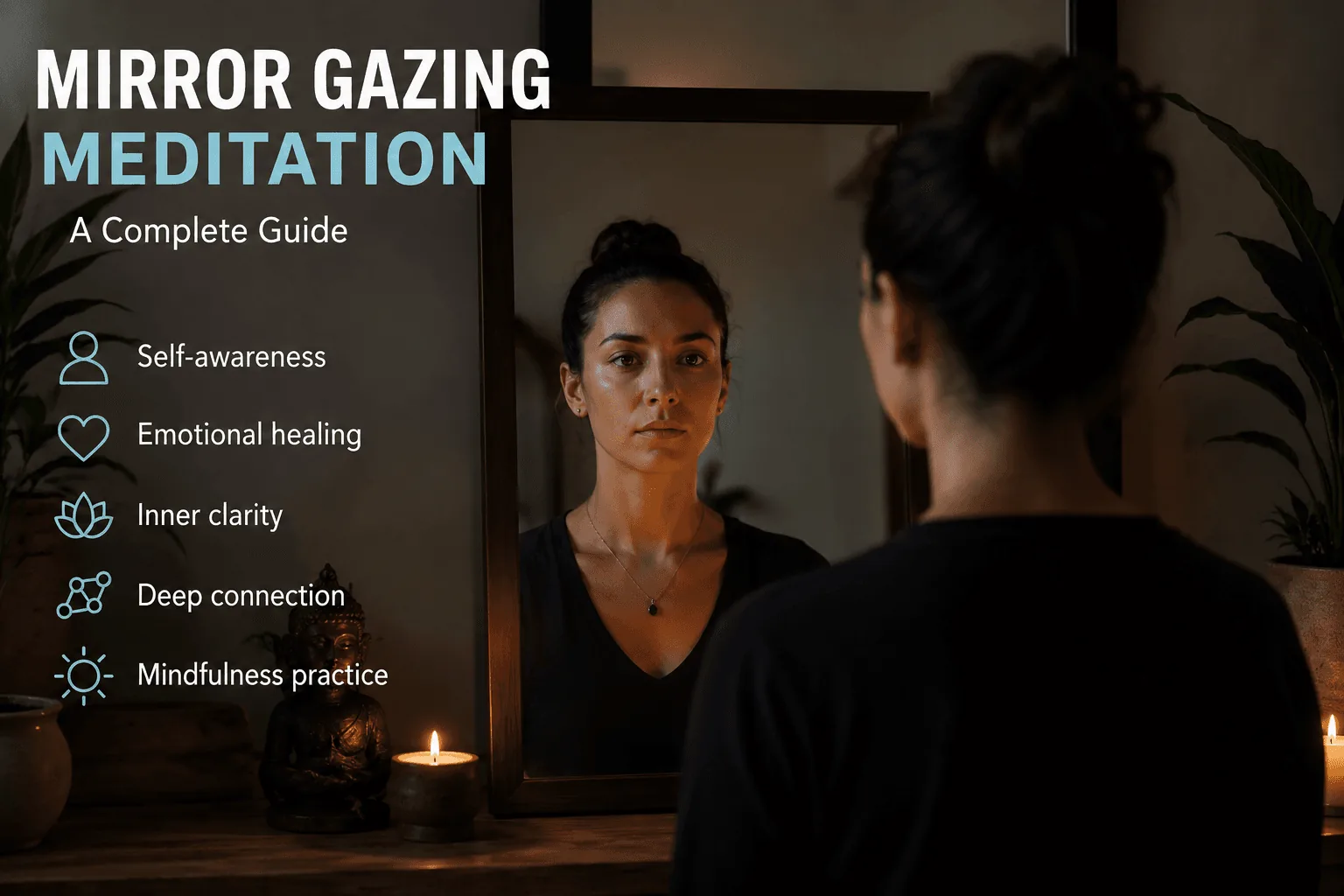
Mirror Gazing: Benefits, Techniques & How to Practice It
Therapists and mindfulness teachers have worked with this practice for a long time, and the reports are consistent enough to be worth taking seriously: it is uncomfortable at first, and it changes how people speak to themselves.

Mirror gazing meditation practice focused on emotional healing, self-awareness, and self-compassion.
What Is Mirror Gazing?
It is a structured attention practice — closer to a body scan done with your own face than to anything mystical.
One well-documented oddity is worth knowing about in advance: after a minute or so of steady mirror gazing in dim light, faces often start to distort or look unfamiliar. This is a normal perceptual effect, it happens to most people, and it is not a sign that anything is wrong.
This is not a hallucination in the clinical sense. It is a window into how the brain constructs identity — and that is precisely what makes the gazing technique therapeutically interesting.

Peaceful mirror gazing meditation setup with candle lighting for mindfulness and emotional relaxation.
The Science Behind Mirror Gazing
How the Brain Processes Self-Recognition
Recognising yourself in a mirror is something we acquire in the second year of life, and it is bound up with the sense of being a separate person. That is part of why the practice can feel unexpectedly loaded.
When you engage in extended mirror gazing, you activate this same neural architecture — but under conditions of sustained attention rather than brief recognition. The result is a different quality of self-perception: slower, more evaluative, more emotionally textured.
Mirror Gazing and Emotional Processing
People who keep the practice up for a few weeks commonly report the same two changes: less automatic criticism when they catch their reflection, and a slightly steadier sense of themselves on difficult days.
If you want to go further, Mirror Meditation by the psychologist Tara Well is the most developed treatment of this practice available, and it is written for a general reader.
Benefits of Mirror Gazing
Emotional and Psychological Benefits
- Increased self-compassion — Regular practice reduces the inner critic’s grip by making self-judgment feel more conscious and therefore more avoidable.
- Improved emotional regulation — Sitting with your own discomfort in the mirror builds the same tolerance that trauma-informed therapists work toward in EMDR and somatic therapies.
- Reduced social anxiety — Sustained eye contact with oneself builds confidence in maintaining eye contact with others, a common anxiety trigger.
- Deeper self-awareness — Most people avoid their own gaze. Mirror gazing reverses that avoidance and reveals what lives beneath it.
Cognitive and Perceptual Benefits
- Heightened interoceptive awareness (awareness of internal body states)
- Improved attentional control through sustained focus practice
- Access to non-verbal emotional cues you may not recognize in daily life
- Disruption of automatic, negative self-appraisal loops
Pros and Cons at a Glance
| Pros | Cons |
|---|---|
| No equipment needed beyond a mirror | Can trigger emotional discomfort, especially initially |
| Backed by peer-reviewed research | Not recommended as a standalone tool for clinical dissociation |
| Integrates easily into existing mindfulness routines | Results require consistency — irregular practice yields little benefit |
| Free and accessible | Low-light protocols may be disorienting for some users |

Mirror gazing meditation session focused on emotional awareness, mindfulness, and self-compassion.
How to Practice Mirror Gazing: Step-by-Step
This gazing technique is designed for beginners starting a consistent practice. Advanced variations are noted where applicable.
Step 1: Set Up Your Environment
Choose a mirror large enough to see your face clearly. Soft, indirect lighting is preferable — bright overhead light tends to activate analytical thinking rather than receptive observation. Many practitioners use a single candle placed slightly behind and to one side, which reduces sensory contrast and supports the relaxed attention the practice requires.
Sit at eye level with the mirror, approximately 18–24 inches away. Remove distractions. Silence your phone.
Step 2: Begin With Breath
Before making eye contact with your reflection, take three slow breaths to settle your nervous system. Inhale for 4 counts, exhale for 6. The extended exhale activates the parasympathetic nervous system, moving you out of reactive mode and into a more receptive state — exactly where this practice works best.
Step 3: Make Soft Eye Contact
Look into your own left eye (your right eye as seen in the mirror). The left eye is widely regarded in psychology and NLP as the more emotionally expressive of the two. Soft gaze — slightly unfocused, not staring — prevents the kind of hyper-vigilant attention that breaks the meditative quality of the practice.
Do not analyze what you see. Do not assess your appearance. Simply observe.
Step 4: Stay With What Arises
Thoughts will come. Judgments will come. The goal is not to stop them but to notice them as they appear — much like observing clouds from a fixed point on the ground. When you find yourself narrating (“I look tired,” “My skin looks bad”), gently return to soft eye contact without self-criticism.
Recommended duration:
- Week 1: 2–3 minutes per session
- Week 2–3: 5–7 minutes per session
- Week 4 onward: 10–15 minutes as comfortable
Step 5: Close With Intention
End each session by placing one hand over your heart and taking a slow breath. This somatic anchor signals closure and integrates what surfaced during the practice. Some practitioners find it useful to journal immediately afterward — not to analyze, but to record whatever images, emotions, or thoughts arose without judgment.
Common Mistakes to Avoid
- Practicing in bright, harsh light — This activates self-criticism rather than self-observation.
- Trying to look attractive — The practice is observational, not evaluative. Grooming impulses are the enemy of depth here.
- Forcing duration too quickly — Building tolerance gradually is more effective than extended sessions that create aversion.
- Stopping when it gets uncomfortable — Mild discomfort is where the practice pays off. Emotional discomfort that feels overwhelming is a signal to pause and ground yourself first.
Expert Perspective
Dr. Tara Well’s mirror meditation framework, developed over a decade of clinical and academic work at Columbia, distinguishes mirror gazing from ordinary self-examination specifically because of its non-evaluative structure. “Most people look in the mirror to fix something,” she has noted in published interviews. “Mirror meditation is about seeing — not assessing.”
Her four-week protocol — which mirrors the structure recommended above — has been tested with populations including people with depression, social anxiety, and body dysmorphic tendencies. In each case, the consistent finding is that the practice creates what Well calls “a compassionate observer” — a psychological stance from which self-criticism loses much of its automatic authority.
This aligns with the clinical mechanism described in Acceptance and Commitment Therapy (ACT): defusion from unhelpful thought patterns through direct, non-reactive observation. Mirror gazing, in this frame, is an exposure practice — one that happens to require nothing more than a mirror and ten minutes.
Mirror gazing costs nothing, needs no equipment you do not already own, and takes five minutes. That combination is rare enough to be worth trying before deciding what you think of it.
What Gets Hard, and What to Do About It
You cannot hold your own gaze for more than a few seconds
Almost universal in the first week, and it tells you something worth knowing rather than something worth fixing immediately. Start at thirty seconds. Genuinely thirty — set a timer, hold the gaze, stop. Build by fifteen seconds every couple of days. Trying to sit for five minutes on day one is how most people conclude the practice is not for them.
You immediately start critiquing your face
Expected, because that is what mirrors have been for. The instruction that helps most is narrow: look only at your eyes, not at your face. The critical commentary needs the whole face to work with, and it loses most of its material when you take that away.
Your face starts to look strange or distorted
This is the well-documented perceptual effect described earlier, and it happens to most people in dim light after a minute or two. It is a quirk of how vision handles a fixed, unchanging image — not a sign of anything psychological. If it unsettles you, turn the lights up and blink normally, both of which stop it.
You get emotional unexpectedly
Common enough that it is worth expecting rather than being alarmed by. Sustained kind attention toward yourself tends to release whatever the usual self-criticism was holding down. If it is brief and leaves you lighter, it is part of the work. If it opens something much older and stays open, that is a signal to bring it to a therapist rather than to sit with it alone — and it often points toward inner child healing rather than a mirror.
It feels vain or self-indulgent
Understandable, and the discomfort is a reasonably good indicator that you need the practice. Vanity is looking to be admired; this is looking without commentary at all. They are different activities that happen to use the same piece of glass.
You keep skipping it
Attach it to an existing mirror moment — brushing your teeth, washing your hands — rather than scheduling a separate appointment with yourself. Thirty seconds after brushing your teeth will survive a bad week. A five-minute morning session will not.
What to Expect, Week by Week
Week one: uncomfortable and faintly ridiculous. You will look away repeatedly and notice how much running commentary there is. That noticing is the entire first week's work.
Week two: holding the gaze gets easier and the commentary quietens a little. Some people report the first moment of something like neutrality here, which sounds unimpressive and is a genuine milestone.
Weeks three and four: the change starts appearing outside the practice — you catch your reflection in a shop window and nothing unkind happens automatically. This is the point most people describe as the practice having worked.
Beyond: the mirror stops being a place where you get judged. Not a place where you get praised either — just a mirror, which is a considerable improvement on what it was.
Start at thirty seconds and build to five minutes over two to three weeks. Sessions longer than about ten minutes offer no extra benefit for most people, and starting too long is the most common reason people give it up after two attempts.
It is a well-documented perceptual effect that appears after a minute or two of steady gazing, especially in dim light — faces can appear to distort or look unfamiliar. It is a quirk of how vision processes a fixed image, not a psychological warning sign. Brighter light and normal blinking stop it.
Your eyes, and nothing else. Looking at your whole face invites the usual critical inventory of features. Narrowing to the eyes removes most of that material and keeps the practice closer to meeting someone than to inspecting yourself.
Yes, and it happens to a lot of people the first few times. Sustained kind attention tends to release what habitual self-criticism was holding down. If it is brief and leaves you lighter, it is part of the process; if it opens something much older that stays open, work with a therapist rather than continuing alone.
Most people find holding their own gaze easier within two weeks, and notice the real change around weeks three and four — catching their reflection unexpectedly without an automatic unkind thought. Practising for thirty seconds daily produces this faster than longer sessions done occasionally.
If gazing suits you but your own face is too confronting a place to start, candle meditation uses the same mechanism with a considerably gentler object.
Frequently Asked Questions
Q1: What is mirror gazing and is it safe? Mirror gazing is the practice of maintaining sustained, intentional eye contact with your own reflection for the purpose of self-inquiry or meditation. It is safe for most people. However, individuals with a history of dissociation, depersonalization disorder, or psychosis should consult a mental health professional before beginning, as the perceptual changes associated with extended mirror gazing may be disorienting.
Q2: How long should a mirror gazing session last? Beginners should start with 2–3 minutes per session and build gradually over four weeks toward sessions of 10–15 minutes. Shorter, consistent sessions produce better results than infrequent long sessions. The key variable is regularity, not duration.
Q3: Why do I see strange images or faces during mirror gazing? This is a well-documented perceptual phenomenon called the “strange-face illusion,” first described by psychologist Dr. Giovanni Caputo. It occurs because the brain’s face-processing systems, under conditions of sustained low-contrast attention, begin adapting and filling in gaps with other representations. It is not a sign of psychological disorder — it is a feature of how the brain constructs identity.
In practice, yes — for most people who stay with it past the first uncomfortable week.
Q5: What is the best time of day to practice mirror gazing? Morning and evening are both viable. Morning practice sets a self-aware, intentional tone for the day. Evening practice, particularly in low light, is better suited to the deeper perceptual work the practice enables. Avoid practicing immediately after high-stress events, as an already-activated nervous system makes non-judgmental observation significantly harder.
Keep reading

The 7 Stages of Emotional Healing: A Practical Guide
What happens at each stage, where meditation genuinely helps, and the flat middle stage that makes most people quit.

Inner Child Healing: How to Start, Without the Woo
The signs an old pattern is running your reactions, six practices that work, and when to stop and see a therapist instead.

Complete Guide to Focus Meditation
In a world of constant distractions, where notifications pull us in a dozen different directions before breakfast,…