Phrases of Compassion: What to Say & How to Mean It
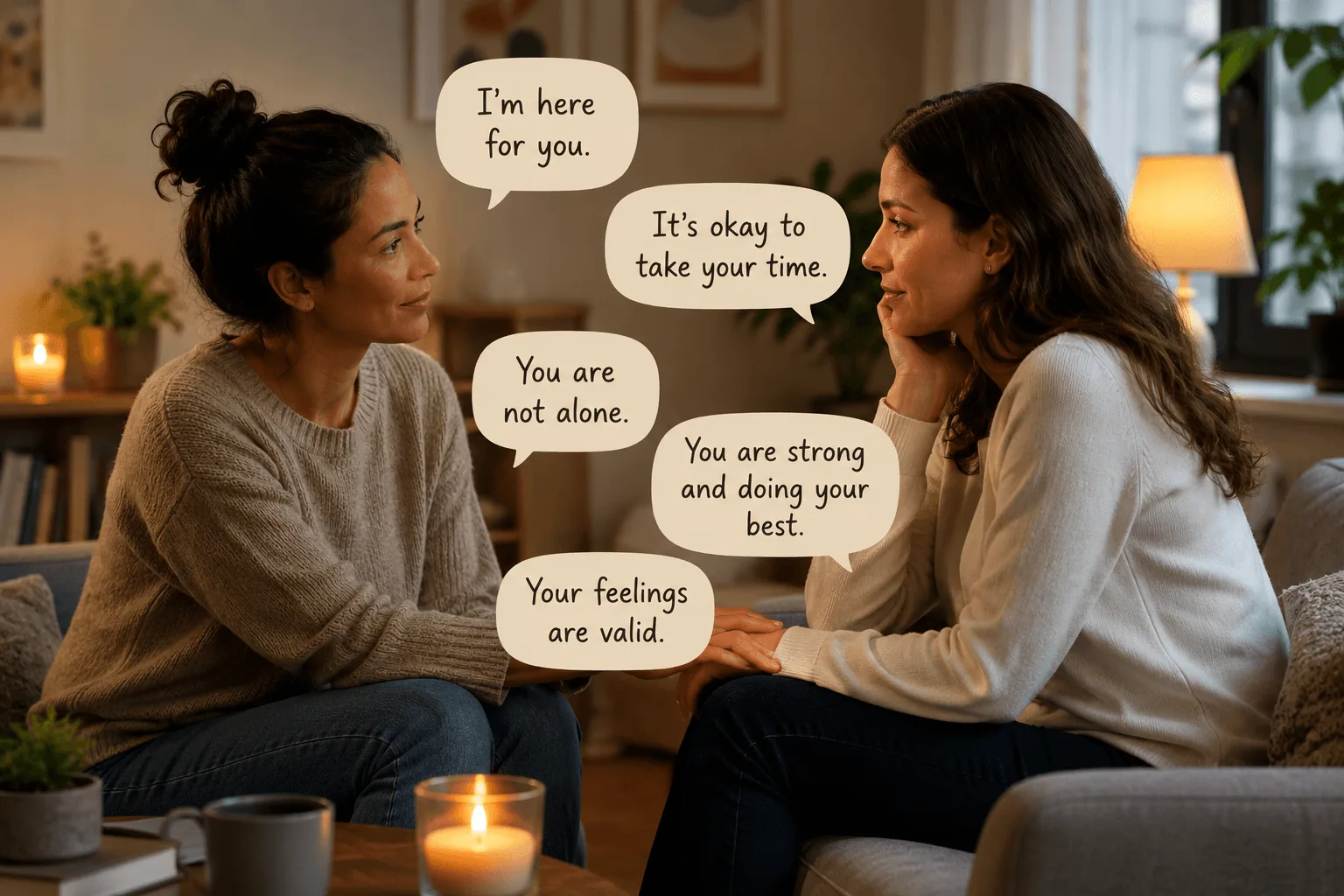
Phrases of Compassion: What to Say & How to Mean It
This article is a practical guide to the words themselves: which phrases land, which ones quietly make things worse, and why the difference is so consistent.
What Makes a Phrase Compassionate?
Sympathy says I feel sorry for you. Compassion says I can see you are suffering, and I want to help. The distinction is not academic — the first puts you above the other person, the second puts you beside them, and people can hear which one they are getting.
A genuinely compassionate phrase does three things:
- Acknowledges the pain without minimizing it — “That sounds incredibly hard” rather than “At least you have your health.”
- Validates the emotional response — “It makes sense that you feel this way” rather than “Try not to worry.”
- Offers presence rather than solutions — “I’m here with you” rather than “Here’s what you should do.”
The absence of any one of these elements moves language out of compassion and into adjacent territory — advice-giving, toxic positivity, or performance of care without substance.
The Research Behind Compassionate Language
Why Words Physically Matter
Attuned, unhurried speech settles both people in a conversation. You can watch this happen: the listener slows down, and so does the person who was speaking.
Being rejected, dismissed or unseen genuinely hurts, in a way most people describe in physical language — a blow, a stab, a weight. That is not a figure of speech people chose at random.
Compassion Versus Empathy Fatigue
One key insight from clinical psychology: compassion is more sustainable than empathy. Empathy — feeling what another person feels — can lead to emotional exhaustion, particularly for caregivers. Compassion — caring about another person’s pain without absorbing it — activates different neural systems and does not deplete in the same way. This is why compassion meditation phrases, used in structured practice, are specifically designed to maintain warmth and care without encouraging merger with the other person’s suffering.

Phrases of Compassion for Everyday Use
When Someone Is Grieving
Grief requires presence more than any other emotional state. Most people say the wrong thing not because they are unkind, but because they are uncomfortable with helplessness. The most effective phrases of compassion in grief:
- “I don’t have the right words, but I’m here and I care about you.”
- “You don’t have to go through this alone.”
- “It’s okay to feel exactly what you’re feeling.”
- “I won’t try to fix this — I just want to sit with you in it.”
- “Tell me about them.” (for loss) — inviting memory is one of the most powerful gifts you can offer.
What to avoid: “Everything happens for a reason,” “They’re in a better place,” “At least you had them for so long.” These phrases redirect from pain toward resolution — the opposite of compassion.
When Someone Is Struggling with Self-Criticism
Self-directed compassion requires a different register than interpersonal compassion, but the principles are the same. Effective phrases when supporting someone in self-judgment:
- “You’re being really hard on yourself right now.”
- “What would you say to a friend who was going through this?”
- “You don’t have to earn rest. You’re allowed to struggle.”
- “Making a mistake doesn’t make you a mistake.”
When You Need to Show Up for Yourself
Self-compassion has been studied carefully for about two decades now, and the consistent finding is the one people find hardest to believe: treating yourself decently makes you more accountable, not less.
Phrases that activate all three:
- “This is a moment of suffering. Suffering is part of life. May I be kind to myself right now.” (Neff’s core self-compassion phrase)
- “I am not alone in feeling this way.”
- “I can be imperfect and still worthy of care.”
Compassion Meditation Phrases: A Practical Guide
Turning compassionate language toward yourself works on the same principle, and most people find it far harder than offering it to someone else.
The Standard Sequence
Compassion meditation phrases are traditionally directed in the following order:
- Yourself — building a foundation of self-compassion before extending outward
- A loved one — someone whose happiness you naturally want
- A neutral person — someone you neither like nor dislike
- A difficult person — someone with whom you have conflict
- All beings — expanding to universal compassion

Core Compassion Meditation Phrases
For each person or group, repeat the following phrases slowly, allowing each one to land before moving to the next:
- “May you be free from suffering.”
- “May you have ease.”
- “May you be happy.”
- “May you know peace.”
These are not wishes in the passive sense. They are active intentions — practiced repeatedly to rewire the brain’s default orientation toward self and others.
Customizing Your Practice
Research supports flexibility in wording. What matters is genuine intention, not precise language. Alternatives that many practitioners find more accessible:
- “I care about your pain.”
- “I wish you relief from this difficulty.”
- “May you find what you need.”
If the standard phrases feel rote, change them. The emotional authenticity of the phrase matters more than its form.
How to Use Phrases of Compassion in Daily Life
Practical Steps for Interpersonal Compassion
- Pause before speaking. The instinct to reassure or fix is fast. Compassion requires a beat of genuine listening first. Ask yourself: have I fully understood what this person just shared before I respond?
- Name what you hear, not what you feel. “That sounds exhausting” centers the other person. “I feel so sad hearing that” centers you. The first is compassionate; the second is empathic but subtly redirecting.
- Ask before advising. “Would it help to talk through some options, or do you just need to be heard right now?” This single question prevents more harm than any particular phrase could cure.
- Follow the person’s lead. Some people need space and silence. Some need words. The most compassionate phrase is often the one you let them choose: “What would feel most helpful right now?”
- A few written sentences of self-compassion often take the edge off within minutes. The effect is small and real, and it is available at 2am when nothing else is.
Integrating Compassion Meditation Phrases into Routine
- Morning: 5 minutes of seated compassion meditation using the standard phrase sequence above
- Transition moments: repeat a single phrase (“May you have ease”) silently when passing a stranger who appears distressed
- Evening: close the day by directing three compassion phrases toward yourself — specifically toward whatever difficulty you encountered that day

Expert Perspective
Dr. Kristin Neff’s research offers a finding that surprises most people: self-compassion is a stronger predictor of emotional wellbeing than self-esteem. Self-esteem fluctuates based on performance and social comparison. Self-compassion remains stable because it is unconditional — it does not require success or superiority to activate.
This means phrases of compassion directed inward are not a consolation prize for failure. They are, neurologically and psychologically, a more effective foundation for resilience than achievement or positive thinking. “The more self-compassionate people are,” Neff has noted in her clinical work, “the more motivated they are to learn from their mistakes — not less.”
The clinical implication for daily life is significant: if you want to improve, criticizing yourself less and responding to failure with compassion phrases is not the soft option. It is the evidence-based one.
Compassionate language is a learnable skill rather than a personality trait. The principles below are simple, and the difficulty is entirely in the doing.
Phrases That Sound Kind and Land Badly
Worth as much attention as the good ones, because most of these are said with genuine warmth and still make the other person feel worse.
| Instead of | Try | Why |
|---|---|---|
| "At least it wasn't worse." | "That sounds really hard." | Ranking pain tells them their reaction is oversized |
| "Everything happens for a reason." | "I don't have anything useful to say, but I'm here." | Explains away something they have not finished feeling |
| "You should try..." | "Do you want ideas, or do you just want to talk?" | Advice before permission reads as impatience |
| "I know exactly how you feel." | "I went through something a bit like that." | The first claims their experience; the second offers company |
| "Let me know if you need anything." | "I'm dropping food round on Thursday." | Open offers put the work on the person least able to do it |
| "Stay positive." | "You don't have to be okay about this." | Positivity as an instruction is a request to stop talking |
The pattern running through the left column: each one, however kindly meant, quietly asks the other person to feel differently so that the conversation becomes more comfortable for you. The right column asks nothing of them at all.
What Gets Hard, and What to Do About It
You freeze and say nothing
Extremely common around grief and serious illness, where people stay silent for fear of saying the wrong thing. Silence is usually read as indifference, and it hurts more than a clumsy sentence. "I don't know what to say, and I didn't want to say nothing" is a complete and genuinely good response.
It comes out sounding scripted
Because you are choosing words while half-listening. Put the phrase down and listen properly for thirty seconds first; the right sentence is almost always in what they just said, and it usually starts with repeating a few of their own words back to them.
They get angry instead of comforted
Sometimes anger is what is available, and it is rarely about you. Do not defend the sentence and do not withdraw the warmth. "That's fair" costs you nothing and keeps the door open, which is the whole job in that moment.
You run out of things to offer
You are allowed to have nothing. Presence with no content is more useful than most content — sitting with someone, making tea, staying on the phone while they say nothing. Compassion is not required to be verbal.
It feels false when you say it to yourself
It does at first, for everyone. The words arrive well before the belief does, and pushing on anyway is the only route through — the same pattern covered in detail in self-compassion.
Timing Matters More Than Wording
A well-chosen sentence delivered in the first hour of a crisis often lands worse than a clumsy one delivered a month later, when everyone else has stopped asking.
The first days bring a flood of attention. What almost nobody gets is the message three weeks in, or on the anniversary, or halfway through the second month when the situation is unchanged and the audience has moved on. That is the point at which people describe feeling most alone, and it is the cheapest moment to be genuinely useful.
Put it in your calendar. It feels mechanical to schedule compassion and it is far better than the alternative, which is intending to check in and then not doing it.
Acknowledge it without trying to fix or minimise it: "that sounds really hard", or "I don't know what to say, and I didn't want to say nothing". Ask whether they want ideas or just want to talk. Specific offers of help work better than open-ended ones.
Avoid "at least it wasn't worse", "everything happens for a reason", "stay positive", and "I know exactly how you feel". Each quietly asks the person to feel differently so the conversation becomes easier for you, and all of them are heard as a request to stop talking.
Because it puts the work of asking on the person with the least capacity to do it. A specific offer removes that burden: "I'm dropping food round on Thursday" or "I'll pick the kids up on Tuesday" is far more likely to be accepted and far easier to receive.
Sympathy says "I feel sorry for you" and places you above the other person; compassion says "I can see you are suffering and I want to help" and places you beside them. People reliably hear which one they are being given, even when the words are similar.
Three weeks later, and on the anniversary. The first days bring a flood of attention that disappears quickly, and most people describe feeling loneliest once everyone else has moved on. Scheduling the later message is worth more than perfecting the first one.
Frequently Asked Questions
Compassion and pity produce different results. Compassion makes you want to help and leaves you steady; pity makes you want to look away, and people on the receiving end feel the difference immediately.
Q2: How do compassion meditation phrases work? Compassion meditation phrases are silently repeated intentions directed toward specific people in a structured sequence — self, loved one, neutral person, difficult person, all beings. Research by Dr. Helen Weng at the University of Wisconsin found that two weeks of practice with these phrases produces measurable changes in brain circuits related to emotional regulation and altruistic behavior. The phrases work through repetition and genuine intention, not passive wishing.
Q3: What are the best phrases of compassion to use when someone is grieving? The most effective phrases in grief are those that offer presence without resolution: “I don’t have the right words, but I’m here,” “You don’t have to go through this alone,” and “Tell me about them.” Avoid redirecting phrases like “Everything happens for a reason” or “At least they lived a long life” — these shift focus away from pain rather than acknowledging it.
Self-directed phrases — May I be kind to myself right now, or I am not the only one who has felt this — work in the same way as the phrases you would offer a friend. They feel false at first. That passes.
Q5: How often should I practice compassion meditation phrases? Most research protocols use daily sessions of 20–30 minutes for clinical outcomes. However, even 5 minutes of daily structured practice produces measurable benefits. Shorter informal practice — repeating a single compassion phrase silently during moments of difficulty — adds meaningful benefit on top of formal sessions. Consistency matters more than duration.
Keep reading

The 7 Stages of Emotional Healing: A Practical Guide
What happens at each stage, where meditation genuinely helps, and the flat middle stage that makes most people quit.

Inner Child Healing: How to Start, Without the Woo
The signs an old pattern is running your reactions, six practices that work, and when to stop and see a therapist instead.

Mindful Living: How to Actually Do It on a Busy Day
Seven anchors that attach to a day you already have, and why "just be present" fails as an instruction.