Pixel Thoughts: Let Go of Negative Thoughts With Mindfulness
Pixel Thoughts: How to Let Go of Negative Thoughts and Calm Anxiety
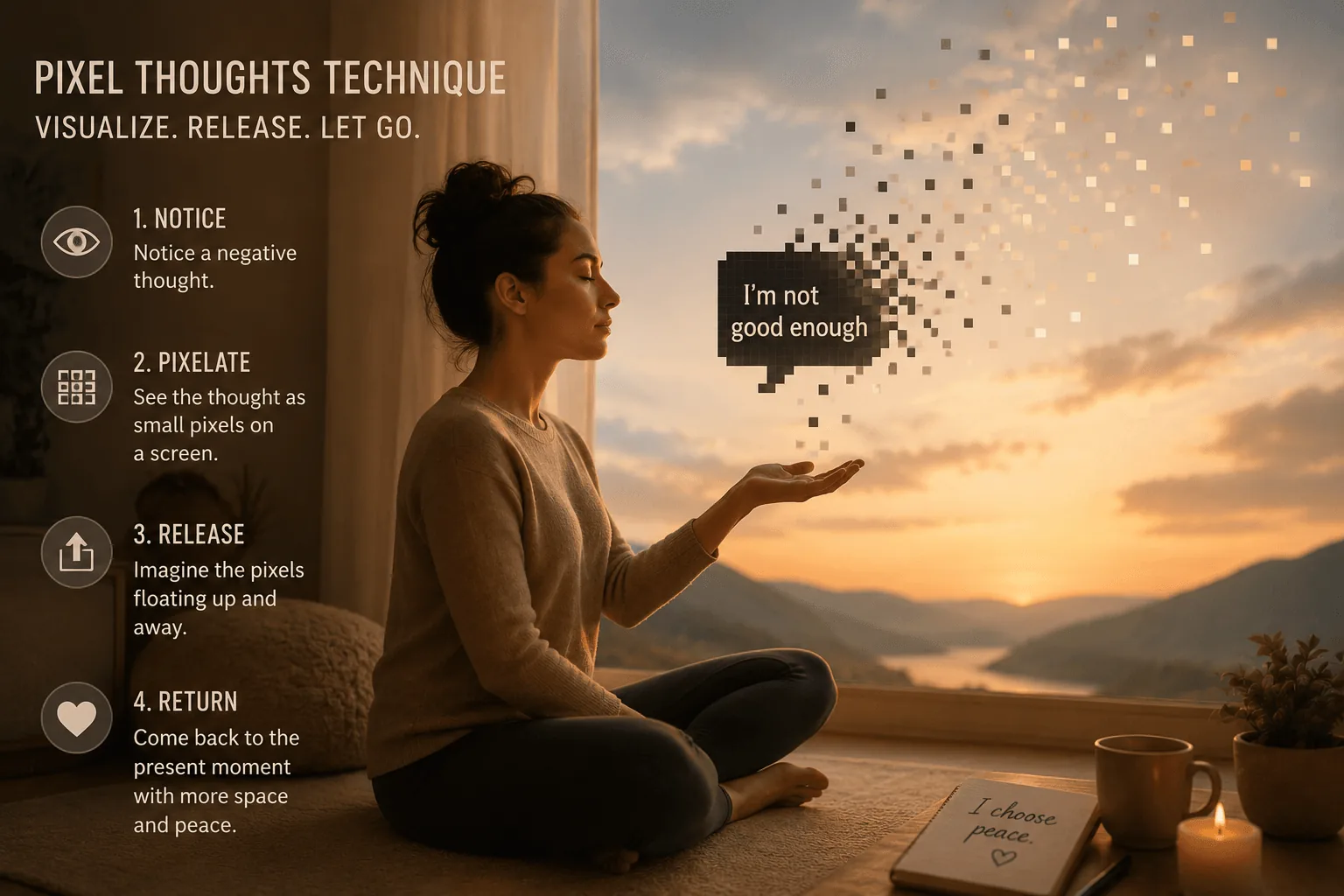
Pixel thoughts is a mindfulness-based visualization technique that helps you release negative thinking by watching a thought shrink to a single pixel and float away. It sounds simple. However, the psychological mechanism behind it is grounded in decades of cognitive science. When you practise pixel thoughts regularly, you stop fighting your mind and start observing it instead. As a result, anxiety loses its grip and letting go of negative thoughts becomes a skill — not a struggle. This article explains how it works, why it works, and how to use it effectively.

What Is the Pixel Thoughts Technique?
Pixel thoughts is a guided visualization exercise. You write or imagine a thought that is causing you distress. Then you watch it slowly shrink — from full size to a tiny pixel — and disappear into a vast, quiet universe.
The Core Idea Behind It
The technique draws from two well-established psychological frameworks. First, it uses cognitive defusion from Acceptance and Commitment Therapy (ACT). Second, it applies visualization-based relaxation from mindfulness-based cognitive therapy (MBCT). Together, these approaches help you see thoughts as mental events — not facts or commands.
Why It Works So Quickly
The pixel thoughts method works fast because it bypasses verbal reasoning. Instead of arguing with a negative thought, you simply observe it change form. As a result, your brain disengages from the thought’s emotional charge. Furthermore, the visual element activates the same neural pathways as guided meditation, producing measurable relaxation within minutes.
The Psychology of Negative Thought Patterns
Before exploring how pixel thoughts helps, it’s worth understanding what you’re actually dealing with.
What Are Negative Thought Patterns?
Negative thoughts are not random. They follow predictable patterns — what cognitive behavioural therapists call cognitive distortions. Common examples include:
- Catastrophising — Assuming the worst outcome is inevitable
- All-or-nothing thinking — Seeing situations in black and white only
- Mind reading — Believing you know what others think about you
- Rumination — Replaying past events in search of a different outcome
- Fortune telling — Predicting failure before something has happened
Additionally, negative thoughts tend to cluster. One worry triggers another. Therefore, the mind can spiral rapidly if nothing interrupts the cycle.
Why the Brain Gets Stuck in Negative Loops
The brain has a negativity bias — a built-in tendency to weight negative information more heavily than positive information. Research by Dr. Rick Hanson at the Greater Good Science Center at Berkeley explains this clearly. The brain, he writes, is “like Velcro for negative experiences and Teflon for positive ones.”
This bias was adaptive for our ancestors. However, in modern life, it produces a constant low-grade anxiety that is difficult to switch off. Letting go of negative thoughts, therefore, requires deliberate counter-training — not just willpower.
How Pixel Thoughts Supports Letting Go of Negative Thoughts
The pixel thoughts technique addresses the negativity bias at its root. It does not try to replace a negative thought with a positive one. Instead, it changes your relationship to the thought itself.
Cognitive Defusion in Action
Cognitive defusion is a core technique in ACT therapy, developed by Dr. Steven Hayes at the University of Nevada. It involves creating psychological distance between you and your thoughts. Instead of being inside the thought, you observe it from outside.
Pixel thoughts makes defusion visual and immediate. You watch a thought shrink and disappear. In doing so, you practise exactly what defusion asks of you: treating a thought as a passing event, not a permanent truth.
The Role of Visualisation in Anxiety Relief
Imagining a scene vividly is not far off experiencing it, as anyone who has tensed up rehearsing a difficult conversation already knows. That is exactly why a visual technique works on a thought that argument cannot touch.
In addition, the vastness of the “universe” backdrop in the pixel thoughts experience puts your thought in perspective. Cognitive researchers call this self-distancing. It reduces emotional intensity without suppressing the emotion.
How to Practise Pixel Thoughts: Step-by-Step
Use this structured approach for best results. You can practise pixel thoughts online at pixelthoughts.co, or you can use the guided steps below mentally.
Step 1: Identify One Thought
Choose a single thought that is causing you anxiety or distress. Be specific. For example: “I’m going to fail this presentation” or “Nobody really likes me.”
Write it down if possible. This step alone creates slight cognitive distance.
Step 2: Observe It Without Judgement
Before letting the thought shrink, simply acknowledge it. Say silently: “I notice I’m having the thought that […].” This is the defusion language from ACT. It places you as an observer rather than a participant.
Step 3: Begin the Visualisation
Now, imagine the thought written in front of you. Slowly watch it shrink. It grows smaller and smaller — from full size, to a word, to a letter, to a dot, to a single pixel. Then it drifts away into a quiet, infinite space.
Breathe slowly throughout. Inhale for 4 counts. Exhale for 6 counts.
Step 4: Return to the Present
When the thought has disappeared, take three slow breaths. Bring your attention to physical sensation — the weight of your hands, the temperature of the air, the feeling of your feet on the floor. This grounds you in the present moment.
Step 5: Repeat as Needed
Pixel thoughts works best with repetition. Use it for any intrusive thought — not just major anxieties. Additionally, practise it proactively: once in the morning and once in the evening, regardless of how you feel. This builds the letting-go reflex over time.

Combining Pixel Thoughts With Other Mindfulness Techniques
Pixel thoughts is powerful on its own. However, it works even better as part of a broader mindfulness practice.
Pair It With Breath Focus
After the visualisation, spend 3–5 minutes on breath focus. Inhale for 4 counts, hold for 4, exhale for 6. This extends the calming window and reinforces the sense that the thought has passed.
Add Journaling for Deeper Release
For recurring negative thoughts, journaling after pixel thoughts deepens the process. Write:
- What the thought was
- What emotion it carried
- What you would say to a friend having that same thought
This integrates letting go of negative thoughts at a cognitive level — not just a visual one.
Use the STOP Technique Between Sessions
Between formal pixel thoughts sessions, use the STOP technique (Stop, Take a breath, Observe, Proceed) whenever a negative thought arises. Together, these tools create a comprehensive toolkit for managing anxious thinking throughout the day.
Expert Perspective: Dr. Steven Hayes and ACT
Dr. Steven Hayes, founder of Acceptance and Commitment Therapy and author of A Liberated Mind, has spent decades researching why people get trapped in negative thoughts — and what genuinely helps.
The Problem With Thought Suppression
Trying not to think about something reliably makes it louder. Try not to think about a white bear for thirty seconds and the mechanism demonstrates itself.
What ACT Research Shows
This is the principle behind acceptance-based approaches in therapy: the aim is not to remove the thought but to hold it more loosely, so that it stops determining what you do next.
In other words, pixel thoughts is not a distraction technique. It is a training tool for one of the most clinically validated skills in modern psychology.
Benefits of the Pixel Thoughts Technique
Psychological Benefits
- Reduces the emotional intensity of intrusive thoughts
- Builds cognitive defusion — one of ACT’s core evidence-based skills
- Decreases rumination and worry loops
- Improves psychological flexibility over time
Practical Benefits
- Takes 2–5 minutes per session
- Requires no equipment — works mentally or online
- Immediately accessible during high-anxiety moments
- Suitable for all ages and experience levels
Pros and Cons of Pixel Thoughts
| Pros | Cons |
|---|---|
| Fast and accessible — works in minutes | Requires practice before it feels natural |
| Grounded in ACT and mindfulness research | Does not address the root cause of chronic anxiety alone |
| Reduces thought intensity without suppression | Best combined with broader mindfulness practice |
| Free to use online at pixelthoughts.co | May feel too simple for sceptical users at first |
| Works for both anxiety and intrusive thoughts | Not a substitute for professional therapy when needed |

Pixel thoughts offers one of the most elegant and accessible entry points into the practice of letting go of negative thoughts. It does not ask you to think positively or push difficult feelings away. Instead, it trains you to watch thoughts change, shrink, and pass — because they always do. The negativity bias is real, and fighting it with willpower rarely works. However, with regular pixel thoughts practice, you build a different skill: the ability to observe your mind without being captured by it. That skill changes everything. Finally, if anxiety is significantly affecting your daily life, combine this practice with professional support for the best results.
Four More Ways to Shrink a Thought
The same principle — change your relationship to the thought rather than argue with its content — has several forms. Different ones work for different people, so it is worth trying more than one.
Say it in a silly voice
Take the sentence that is bothering you and repeat it internally in a cartoon voice, or sing it. It feels absurd, which is exactly the point: the thought loses authority when the delivery undermines it, and authority was most of what made it feel true.
Add the preamble
Instead of I am going to mess this up, use I am having the thought that I am going to mess this up. The extra words are clumsy and they do something precise — they put you outside the thought rather than inside it, which is the whole move.
Change the pronoun
Narrate the worry in the second person: you're worried about tomorrow rather than I'm worried about tomorrow. The small grammatical distance is disproportionately effective at cooling things down and can be done mid-conversation without anyone noticing.
Put it on the schedule
When a worry keeps returning, give it an appointment: fifteen minutes at six o'clock, notebook, worrying as the assigned activity. A mind that knows it has a slot booked interrupts you considerably less in the meantime, and most worries have lost their urgency by the time the slot arrives.
What Gets Hard, and What to Do About It
The thought comes straight back
It will, and that is not failure. You are not deleting anything — you are practising a different response to its arrival. Measured over weeks, what changes is how long it holds you, not whether it appears.
You start using it to avoid a real problem
The genuine risk with any distancing technique. If the thought is I have not filed my tax return, the correct move is to file the tax return. These tools are for thoughts that recur without leading anywhere, not for the ones pointing at something you need to do.
It works for small thoughts and not big ones
Expected. Distancing techniques handle everyday rumination well and are not a treatment for grief, trauma or clinical anxiety. If the thought is about something genuinely serious, the honest answer is that it needs a person rather than a technique.
You feel detached rather than relieved
A sign of overuse. The aim is distance from the thought, not from your own life. If everything starts feeling remote, stop the technique and do something physical and concrete — a walk, cooking, the washing up with your attention on the washing up.
You forget the tool exists when it matters
Practise it on something trivial while calm. A technique first attempted at two in the morning has no chance; one you have rehearsed on a mildly annoying email has a good one. The same logic as any breathing exercise.
Change your relationship to it rather than arguing with its content. Add a preamble — "I am having the thought that…" — narrate it in the second person, repeat it in a silly voice, or give the worry a scheduled fifteen-minute slot later in the day. All four create distance without requiring the thought to be false.
Because suppression requires monitoring for the very thing you are avoiding, which keeps it active. Try not to think about a white bear for thirty seconds and the mechanism demonstrates itself. Distancing works where suppression fails because it does not require the thought to go away.
No — that is expected and is not a sign the technique failed. You are practising a different response to its arrival rather than deleting it. What changes over weeks is how long it holds you, not whether it appears.
When the thought is pointing at something real you need to act on. If it is "I have not filed my tax return", the answer is to file it. Distancing tools are for thoughts that recur without leading anywhere, not for a to-do list wearing a worry costume.
That usually means overuse. The aim is distance from the thought, not from your life. Stop the technique and do something physical and concrete — a walk, cooking, washing up with your attention actually on it — until things feel immediate again.
Frequently Asked Questions
What is the pixel thoughts technique?
Pixel thoughts is a mindfulness-based visualisation exercise. You focus on a negative or anxious thought and watch it shrink to a single pixel before disappearing into a vast universe. It draws from cognitive defusion in ACT therapy, which helps you observe thoughts as mental events rather than facts. Therefore, it reduces the emotional intensity of the thought without requiring you to argue with it or push it away.
How does pixel thoughts help with anxiety?
Pixel thoughts reduces anxiety by creating psychological distance between you and your thoughts. Research on cognitive defusion — the ACT technique it draws from — shows that this distance reduces the thought’s emotional charge and behavioural impact. Additionally, the visualisation activates the same neural calming pathways as guided meditation. As a result, most people feel a noticeable reduction in anxiety within a few minutes of practice.
How often should I practise pixel thoughts?
For best results, practise pixel thoughts at least once daily — ideally morning and evening. Additionally, use it in the moment whenever an intrusive or anxious thought arises. Like any mindfulness skill, consistency matters more than duration. Therefore, short daily sessions build the letting-go reflex far more effectively than occasional longer ones.
Can pixel thoughts replace therapy for anxiety?
Pixel thoughts is a valuable self-help tool backed by ACT research. However, it is not a replacement for professional therapy, particularly for clinical anxiety disorders, OCD, PTSD, or depression. It works well as a daily practice alongside therapy — or as a preventative tool for everyday stress and worry. If anxiety significantly affects your daily functioning, please seek support from a qualified mental health professional.
Where can I try pixel thoughts online?
The original pixel thoughts visualisation tool is available free at pixelthoughts.co. The website guides you through the complete visualisation with calming music and animation. Additionally, you can practise the technique mentally using the step-by-step guide in this article — no internet connection required. Finally, several meditation apps now include similar visualisation exercises under cognitive defusion or thought-release categories.
Keep reading

The 7 Stages of Emotional Healing: A Practical Guide
What happens at each stage, where meditation genuinely helps, and the flat middle stage that makes most people quit.

Inner Child Healing: How to Start, Without the Woo
The signs an old pattern is running your reactions, six practices that work, and when to stop and see a therapist instead.

Mindful Living: How to Actually Do It on a Busy Day
Seven anchors that attach to a day you already have, and why "just be present" fails as an instruction.