Why Is It Important to Know Yourself? Self-Knowledge Explained

Why Is It Important to Know Yourself? The Psychology of Self-Knowledge and Emotional Self-Insight
Understanding why it is important to know yourself may be the single most valuable insight you ever develop. Not because it sounds wise — but because without it, you are making the most important decisions of your life with incomplete information. Your relationships, your career choices, your emotional reactions, your patterns under stress — all of these are shaped by forces inside you that most people never examine.
Self-knowledge is not a luxury. It is a foundation. And the people who build it tend to live with far greater clarity, calm, and purpose than those who do not.
Here is what the research — and real human experience — tells us about why knowing yourself changes everything.

What Self-Knowledge Actually Means in Daily Life
Self-knowledge is not about labeling yourself with a personality type or knowing your star sign. It means developing accurate, honest insight into your own thoughts, emotions, values, triggers, and patterns.
It means understanding:
- Why you react strongly to certain situations
- What you truly need versus what you think you want
- Which relationships drain you and which restore you
- How your past experiences shape your current responses
- What you value when you strip away what others expect of you
This kind of clarity does not come automatically. However, it is absolutely learnable — and the practices that build it are simpler than most people expect.
The Gap Between Who We Think We Are and Who We Actually Are
There is a well-known gap in this area that is worth sitting with for a moment, because almost everyone assumes they are on the right side of it.
This gap matters. When you operate without accurate self-knowledge, you tend to repeat the same emotional patterns, attract the same relationship dynamics, and feel confused about why certain areas of life never seem to improve.
Understanding why it is important to know yourself begins with accepting that most of us know ourselves far less than we assume.
Why Is It Important to Know Yourself? 6 Life-Changing Reasons
The benefits of self-knowledge touch nearly every area of mental and emotional well-being. Here are six of the most important.
1. You Make Better Decisions
When you know your core values, you stop making choices based on other people’s expectations or momentary emotions. Instead, you align decisions with what genuinely matters to you. As a result, your choices feel more deliberate and your regrets become fewer.
2. Your Emotional Reactions Become Manageable
Most emotional outbursts happen because a trigger touches something unexamined inside us. When you understand why certain situations provoke strong reactions, you gain a pause between stimulus and response. That pause is where conscious choice lives.
3. Relationships Improve Dramatically
Knowing yourself helps you communicate what you need, recognize what others need, and spot dynamics that are unhealthy before they cause lasting damage. Research consistently shows that self-awareness is one of the strongest predictors of relationship satisfaction.
4. Anxiety and Stress Decrease
A significant portion of chronic anxiety stems from internal conflict — wanting things that contradict each other, or living in ways that conflict with your values. Self-knowledge resolves those conflicts. Therefore, anxiety often decreases not because life becomes easier, but because your inner world becomes more coherent.
5. You Stop People-Pleasing
When you do not know yourself, you define yourself through others’ approval. Self-knowledge creates an internal reference point. You begin making choices from your own values rather than other people’s reactions.
6. Personal Growth Becomes Possible
You cannot change what you cannot see. Self-knowledge is the prerequisite for every meaningful form of personal development. Without it, growth is accidental. With it, growth becomes intentional.
Practical Ways to Build Self-Knowledge Starting Today
Understanding why it is important to know yourself is helpful. Actually building that knowledge requires consistent, deliberate practice. Here are the most effective methods — all beginner-friendly and immediately applicable.
Start a Daily Reflection Practice
Set aside five to ten minutes each evening to ask yourself three questions:
- What emotion showed up most strongly for me today?
- What triggered it — and why might that trigger exist?
- Did my actions today align with what I actually value?
You do not need to have perfect answers. The act of asking these questions regularly trains your mind to observe itself — the foundational skill of self-knowledge.
Use a Self-Awareness Journal
Writing is one of the most powerful tools for developing emotional self-insight. Unlike thinking, writing forces you to articulate vague internal experiences into clear language. That clarity is itself a form of self-knowledge.
Try these prompts to get started:
- “The emotion I find hardest to sit with is _____, because _____.”
- “When I feel overwhelmed, I tend to _____.”
- “The type of situation that consistently drains my energy is _____.”
- “The values I want to guide my life are _____, but I often act against them when _____.”
Write without editing yourself. The raw, uncensored response usually contains the most honest self-knowledge.
Try a Body Scan Meditation
Your body holds emotional information your mind has not yet processed. A body scan meditation — simply moving your awareness slowly from head to feet and noticing areas of tension, tightness, or discomfort — builds what psychologists call interoceptive awareness: the ability to notice internal physical signals.
This practice directly supports emotional self-insight. Many people discover that what they labeled “anxiety” is actually grief, or what felt like “anger” is actually fear. The body distinguishes these emotions long before the mind does.
Identify Your Emotional Triggers
Make a simple list of recurring situations that produce strong emotional reactions. For each one, ask: “What does this situation mean to me? What does it threaten?” Often, the answer reveals an unmet need or an unhealed wound — both of which are essential pieces of self-knowledge.
Seek Honest Feedback
Ask two or three people you trust a simple question: “When have you seen me at my best — and when have you noticed me being less than I want to be?” Most people never ask this. However, the answers provide external data that complements your internal reflection.

What Mindfulness Adds to Self-Knowledge
Mindfulness and self-knowledge reinforce each other directly. Mindfulness trains you to observe your thoughts and emotions without being swept away by them. This observational distance is exactly what genuine self-knowledge requires.
A self-aware mind is one that can watch its own activity without immediately becoming it. You notice the anger rather than simply being angry, and that small separation is what makes a different response possible.
In practice, even a five-minute mindfulness meditation each morning builds the observational muscle that self-knowledge depends on. You are not just calming your nervous system. You are practicing the art of knowing yourself more clearly, one breath at a time.
Pros and Cons of Pursuing Deeper Self-Knowledge
Pros
- Greater emotional stability and resilience
- Clearer decision-making aligned with personal values
- Reduced anxiety and internal conflict
- Stronger, more honest relationships
- More effective communication of needs and boundaries
- A genuine sense of identity not dependent on external validation
Cons
- The process can surface uncomfortable truths you have been avoiding
- It requires sustained honesty, which takes courage
- Initial stages can temporarily increase self-critical thinking before self-compassion develops
Although the discomfort is real, it is temporary. Most people who commit to self-knowledge work report that the difficult discoveries — while initially unsettling — ultimately bring enormous relief. Knowing the truth about yourself, however uncomfortable, is always less exhausting than avoiding it.
Knowing Yourself Is the Work That Changes Everything
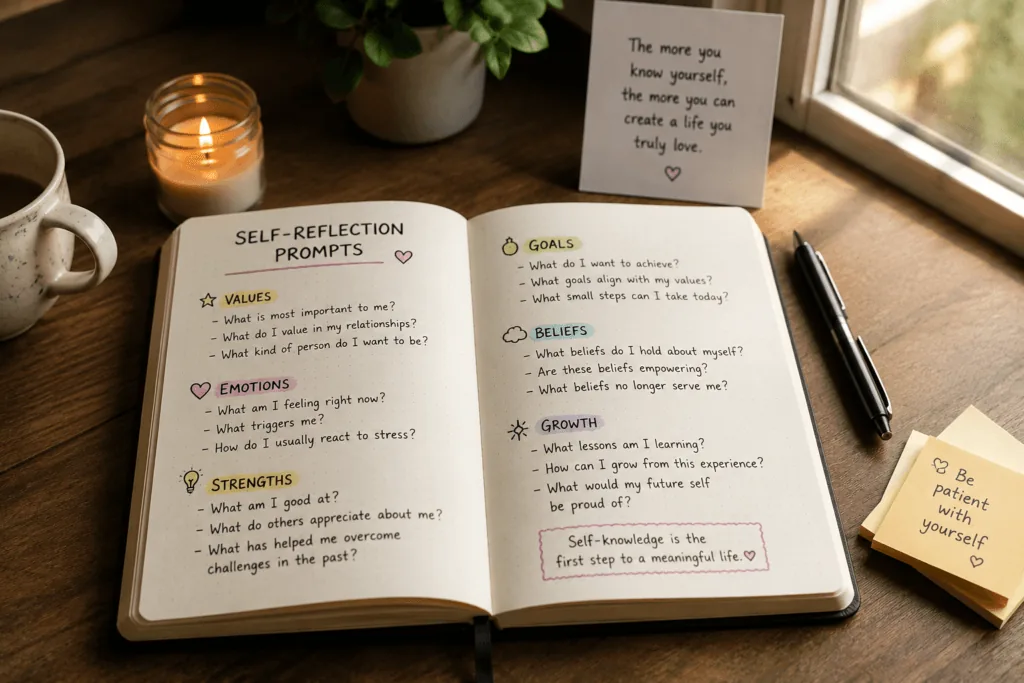
Understanding why it is important to know yourself is not a philosophical exercise. It is a practical necessity for anyone who wants to live with genuine clarity, emotional stability, and purpose.
When you know yourself — your values, your patterns, your triggers, your needs — you stop reacting blindly and start responding consciously. You stop building your life around other people’s definitions and start constructing one that actually fits who you are.
The practices are simple. The commitment is daily. And the return — a life lived from the inside out — is profound.
Start tonight. Five minutes. Three honest questions. That is enough to begin.
Seven Questions That Actually Reveal Something
Most self-knowledge prompts produce answers you already had. These are chosen because they tend to produce answers you did not.
- What do I complain about repeatedly and never act on? The gap between the two is usually where a fear lives.
- What am I like when I am tired? Not your best self — that one is easy to describe. Your default under load is the more accurate portrait.
- What kind of person irritates me disproportionately? Frequently a trait you have suppressed in yourself, or one you envy.
- What do I do when nobody has asked me to do anything? An unstructured Saturday is a better values test than any questionnaire.
- What compliment makes me uncomfortable? Discomfort with praise usually marks a belief about yourself the praise contradicts.
- What would I do if it were guaranteed nobody would find out? Worth answering privately and honestly, then noticing what the answer says.
- Who do I become around my family? Old roles reassert themselves fastest where they were formed, which makes them easiest to observe there.
Answer one properly rather than all seven quickly. The quick pass produces the version of yourself you have already told other people about, which is the version you were trying to get behind.
What Gets Hard, and What to Do About It
You find things you would rather not have found
That is the process working, and it is why self-knowledge has a reputation for being uncomfortable. The useful move is to hold the finding without a verdict attached — noticing that you are competitive with a friend is information; deciding you are a bad person about it stops the inquiry dead.
You confuse self-knowledge with self-analysis
Endless internal commentary about why you are the way you are can feel like insight while functioning as rumination. The distinguishing test is simple: insight changes something within a week or two. Analysis that never touches behaviour is a hobby.
Other people describe you differently than you describe yourself
Almost always the case, and their version is not automatically wrong. Ask two people you trust what you are like to be around when you are stressed. The answers are usually specific, mildly unwelcome, and more accurate than your own account.
You know yourself well and behave the same anyway
Very common, and it means insight has arrived without practice. Knowing your pattern does not interrupt it — noticing it happening does, and that is a trainable skill rather than an intellectual one. This is precisely what sitting practice builds, and where mindful living earns its place.
It turns into a personality-test collection
Frameworks are useful as vocabulary and useless as verdicts. If a result explains everything you do, it has stopped being a tool and become a story you are now defending.
What to Expect
First few weeks: mostly retrospective. You spot the pattern hours after it ran. That is the correct first milestone.
Months two and three: you catch things closer to the moment, and occasionally during. Recovery from a bad reaction gets noticeably faster.
Months four to six: the small decisions start changing — what you agree to, what you stop pretending to enjoy, who you spend a free evening with.
Beyond: less energy spent maintaining a version of yourself that was not quite accurate. That freed-up energy is the real return, and most people describe it simply as being tired less often.
Because most of the energy people spend on stress goes into maintaining a version of themselves that is not quite accurate. Knowing your actual patterns — how you behave when tired, what you avoid, what you resent — makes decisions easier and reactions shorter.
Ask questions that produce answers you did not already have: what do I complain about and never act on, what am I like when tired, what kind of person irritates me disproportionately, what do I do when nobody has asked anything of me. Answer one properly rather than all of them quickly.
Insight changes something within a week or two; analysis that never touches behaviour is a hobby that feels like progress. Endless commentary about why you are the way you are is usually rumination wearing the costume of self-awareness.
Because knowing a pattern intellectually does not interrupt it — only noticing it as it happens does, and that is a trainable skill rather than an insight. Short daily attention practice is what turns knowledge about yourself into a gap you can act in.
They are useful as vocabulary and unhelpful as verdicts. If a result seems to explain everything you do, it has stopped being a tool and become a story you defend — which is the opposite of the openness self-knowledge requires.
Frequently Asked Questions
Why is it important to know yourself for mental health?
People who know themselves well tend to be less stressed, recover faster from setbacks, and are noticeably easier to work with — mostly because they are not defending a version of themselves that does not exist.
What is self-knowledge and how is it different from self-esteem?
Self-knowledge refers to accurate insight into your thoughts, emotions, values, triggers, and behavioral patterns. Self-esteem, however, refers to how positively you regard yourself. They are related but distinct. You can have high self-esteem without genuine self-knowledge — and that gap often leads to blind spots and repeated mistakes. True self-knowledge includes both strengths and limitations, viewed honestly and without excessive judgment. Therefore, it supports healthier self-esteem because it is grounded in reality rather than self-image.
How does mindfulness help build self-knowledge?
Mindfulness trains you to observe your thoughts and feelings without immediately reacting to them. This observational distance is the foundation of emotional self-insight. When you sit with your experience — even for five minutes each morning — you begin to notice patterns, recurring emotions, and habitual responses that previously operated unconsciously. Over time, this practice builds the self-awareness that makes genuine self-knowledge possible. Additionally, it calms the nervous system, creating the inner stillness required for honest self-reflection.
How long does it take to develop real self-knowledge?
Self-knowledge is not a destination — it is an ongoing practice. However, most people notice meaningful shifts in self-awareness within four to six weeks of consistent daily reflection, journaling, or mindfulness practice. The deeper layers — understanding core wounds, unconscious patterns, and value conflicts — often emerge over months or years. Therefore, approach it with patience and curiosity rather than urgency. Small, honest daily practices accumulate into profound self-understanding over time.
Can knowing yourself help with anxiety?
Greater self-insight consistently goes with lower anxiety and less reactivity. It is not a comfortable process, and it is a reliably worthwhile one.
Keep reading

Complete Guide to Focus Meditation
In a world of constant distractions, where notifications pull us in a dozen different directions before breakfast,…

What to Be Grateful For: How Gratitude Improves Mental Health
What to Be Grateful For: How Practicing Gratitude Can Improve Your Mental Health and Happiness Knowing what you are…

How to Be Consciously Focused on the Present Moment Every Day
How to Stop Living on Autopilot and Become Consciously Focused on the Present Moment Being consciously focused on the…