Body Scan Meditation for Sleep: A Step-by-Step Guide
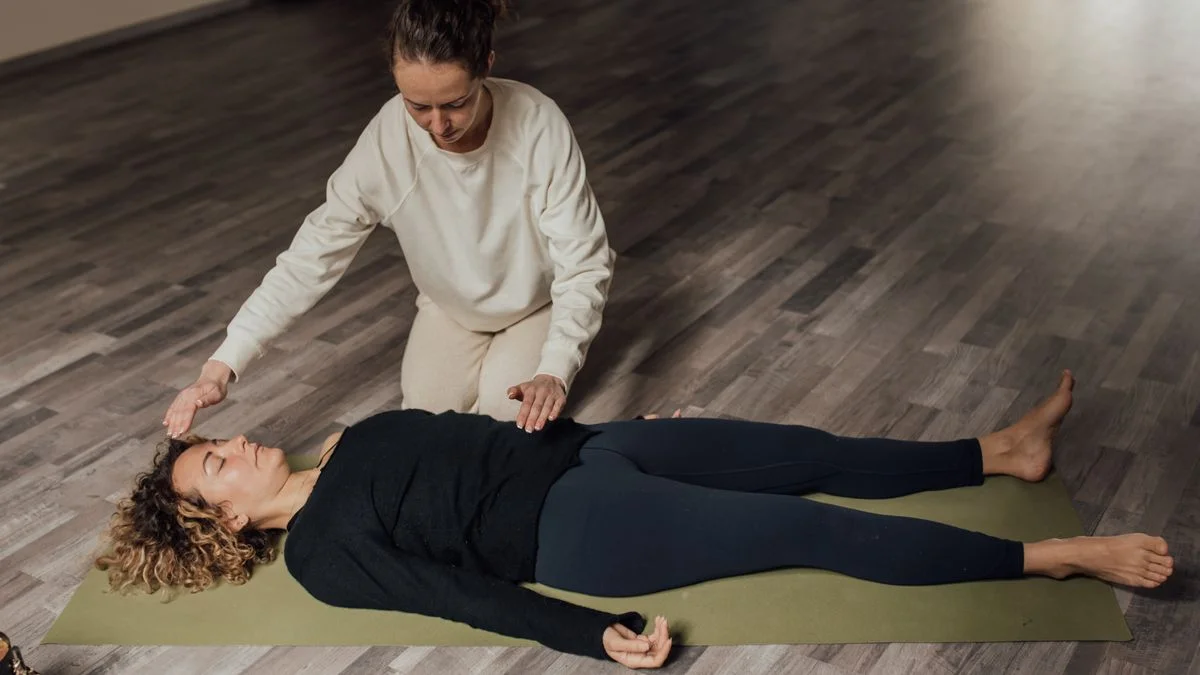
There is a specific kind of tired where your body is finished and your mind is still filing paperwork. You have been in bed forty minutes. You have checked the time twice. And the harder you try to fall asleep, the more awake you become — because trying is an activity, and activities keep you up.
A body scan solves this by giving your attention a job so dull and so physical that the filing stops on its own. You are not trying to sleep. You are moving attention slowly through your body, one region at a time, which happens to be almost exactly what your nervous system does anyway on the way down.
Most people fall asleep before they reach their knees, and worry that they did it wrong. They did not. Why that is fine — and the one case where it genuinely is a problem — comes later.
Key takeaways
- A body scan moves attention slowly through the body without trying to change anything.
- Falling asleep partway through is a success when the goal is sleep, and only a problem when the goal is awareness.
- Go feet to head for sleep. Head to feet works better when you want to stay alert.
- Do not try to relax each part. Noticing is the instruction; relaxing is a side effect.
- Ten minutes is plenty. Forty-minute versions exist and are not more effective for sleep.
What Is a Body Scan Meditation?
A body scan is a meditation in which you move your attention slowly and deliberately through the body — usually one region at a time, from the feet to the head or the reverse — noticing whatever sensation is present without trying to change it. It is one of the most widely taught mindfulness practices and one of the easiest to learn.
The word "scan" is slightly misleading. You are not inspecting yourself for problems, and there is no report at the end. A better image is a torch beam moving slowly across a dark room: it lights up whatever is there, does not rearrange the furniture, and moves on.
The body scan is one of the core practices in mindfulness-based stress reduction programmes, which is where most people in the West encounter it for the first time. That lineage matters mainly because it means the instructions have been refined over decades of teaching people who found it difficult.
Why It Works So Well for Sleep
Three reasons, all fairly mundane.
First, it occupies the part of your mind that would otherwise be rehearsing tomorrow. Attention is largely single-channel; if it is genuinely on your left calf, it is not on the email you should have sent.
Second, it moves attention out of the head and into the body. Most nighttime rumination is verbal, and sensation is not verbal. Shifting registers is easier than arguing your thoughts into silence, which does not work anyway.
Third, it removes the effort. You are not attempting to fall asleep, so you cannot fail at falling asleep — and the anxiety about not sleeping, which is often the actual thing keeping you awake, loses its object. This is why it outperforms "just relax" so consistently.
How to Do a Body Scan for Sleep
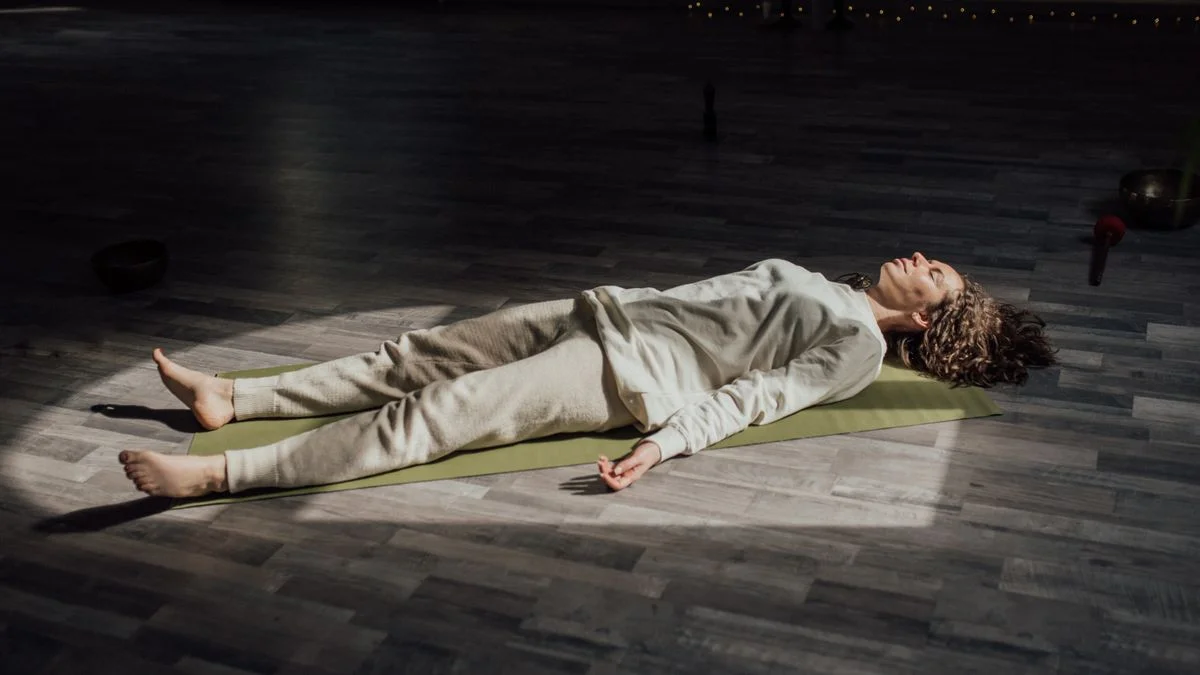
Lying on your back, in bed, lights off. No app required. Read this once and you will not need to read it again.
If you like the body scan but want something with a beginning and an end built around it, our yoga nidra script extends the same idea into a full twenty-five minute practice you can record and follow.
1. Settle and take three slow breaths
Let the exhale be longer than the inhale — roughly four in, six out. Three of these is enough. If breathing patterns interest you, the full set is in our breathing exercises guide, but for this practice three ordinary long exhales will do.
2. Start at the feet
Bring attention to your left foot. Not to an idea of your foot — to whatever is actually detectable there: warmth, coolness, pressure of the sheet, a faint ache, or nothing at all. Nothing is a legitimate finding. Stay for about twenty seconds, then move to the right foot.
3. Move up in unhurried steps
Ankles, calves, knees, thighs. Hips and lower back. Stomach and chest. Hands, forearms, upper arms, shoulders. Neck and throat. Jaw, face, scalp. Roughly twenty to thirty seconds per region. If you are still awake at your face, you have done well.
4. Do not try to relax anything
This is the instruction people most often get wrong, and getting it wrong is what makes the practice feel like work. You are not commanding your shoulders to drop. You are noticing they are tight. The dropping happens on its own once the tightness has been observed rather than fought.
5. When your mind wanders, resume where you left off
It will wander. Often you will realise you have been somewhere else for two minutes. Simply return to the last region you remember and carry on — no restarting from the feet, no assessment of how badly it is going.
6. Finish by sensing the whole body
If you make it to the top, spend a final minute sensing the body as one thing rather than a series of parts — its weight, its outline, the bed underneath it. Then stop. For sleep, do not add anything after this.
Setting Up So It Actually Works
Small practical things, all of which people get wrong at least once.
Do it in bed only if you want to sleep. If you are practising to build the skill, do it somewhere else — a chair, the floor, a sofa. Otherwise you train your body to associate the practice with switching off, and then wonder why the daytime version makes you drowsy.
Cooler rather than warmer. A slightly cool room with enough covering works better than a warm one. Body temperature drops naturally as you fall asleep, and a hot room fights that.
Arms slightly away from the body, palms up or down. Whichever is comfortable. Uncrossed limbs simply make each region easier to find.
Skip the recording, at least sometimes. Guided audio is a fine way to learn, but a voice that pauses when you are ready to move on — or moves on when you are not — becomes an obstacle. Once you know the sequence, your own pace is better, and you are not dependent on a device at 3am. If you are entirely new to practising without guidance, meditation for beginners covers the transition.
No clock. Not a timer, not a phone face-down on the bedside table. Checking the time is the fastest way to reintroduce the effort you were trying to remove.
Feet to Head, or Head to Feet?
It matters more than it sounds.
Feet to head is the version for sleep. Starting far from the head and moving toward it draws attention downward and away from thinking first, which is why almost every sleep recording uses this direction.
Head to feet is the version for daytime awareness. Starting at the face keeps you more alert, and it finishes with the feet on the floor, which is grounding rather than sedating. Use this one for a midday reset or a pre-work practice.
If you have been doing head-to-feet at bedtime and finding it does not help you sleep, this is very likely why.
How Long Should It Take?
| Purpose | Length | Position |
|---|---|---|
| Falling asleep | 10-20 min (you will not finish) | Lying down, in bed |
| Waking at 3am | Whatever it takes | Lying down, no clock |
| Daytime reset | 5-10 min | Seated or lying, head to feet |
| Building the skill | 15-20 min | Seated or lying, not in bed |
| Very tense body | 20-30 min | Lying on the floor |
Longer is not better. If you are choosing between twenty minutes twice a week and eight minutes nightly, take the eight — the same logic that applies to how long you should meditate generally.

What Gets Hard, and What to Do About It
You fall asleep every time
The loop from the opening, closed. If your goal is sleep, this is not a problem — it is the practice working, and there is no prize for reaching your scalp. It only becomes a problem if you also want the awareness benefits, in which case do a second scan during the day, sitting up, somewhere that is not your bed. Two different practices with the same shape.
You cannot feel anything in some areas
Completely normal. Some regions report clearly and some report nothing, and the blank ones are often the tightest. Do not go hunting. Note "nothing here" and move on — the sensitivity develops over weeks without being forced.
It makes you more aware of pain
It can, at first. The adjustment is to give a painful area the same twenty seconds as everywhere else rather than either avoiding it or camping there. Many people with persistent pain find that the relationship to it changes even when the sensation does not — but if attention on the pain reliably makes things worse, keep the scan to unaffected areas and speak to your clinician.
If simply observing a tight area is not enough to release it, the tense-and-release version often works better as a starting point — see our progressive muscle relaxation script, which teaches the contrast before asking you to notice it.
You get restless or itchy
Very common in the first fortnight, and usually a sign your system is not used to being still. You are allowed to scratch. Scratch, then return. Rigidity about not moving turns a calming practice into an endurance test.
It makes you anxious rather than calm
For some people — particularly with a history of trauma — turning attention inward is activating rather than settling. If that is you, keep your eyes open, sit up rather than lying down, scan only hands and feet, and keep it under three minutes. If it is still difficult, an external anchor such as sound works better than the body, and this is worth raising with a therapist rather than pushing through.
You keep losing your place
Then the regions are too small. Use six large blocks instead of twenty small ones: legs, hips, torso, arms, neck, head. Precision is not the point, and a rough scan you actually complete beats a detailed one you abandon.
What to Expect, Week by Week
Week one: you fall asleep quickly some nights and lie there mentally narrating on others. Both are normal. Do not evaluate yet.
Weeks two and three: falling asleep gets faster and more consistent. You also start noticing tension during the day — a clenched jaw at your desk — which is the practice generalising.
Weeks four to eight: the scan becomes something you can do in ninety seconds when you need it, including in a chair before a difficult meeting.
Beyond: for most people, the body becomes a reliable place to put attention when the mind is unhelpful. That is a genuinely useful thing to own, and it is the real return on the practice.
If holding a seated position is the difficulty rather than the scan itself, meditation posture covers how to sit without your legs going numb.
Not if your goal is sleep — falling asleep partway through means it is working, and there is no benefit to reaching the end. It is only a drawback if you also want the awareness benefits, in which case do a second scan during the day, sitting up and away from your bed.
Ten to twenty minutes is plenty, and most people fall asleep long before finishing. Longer recordings are not more effective for sleep. A short scan done nightly beats a long one done occasionally.
Start at the feet and move upward for sleep — it draws attention away from thinking first. Start at the head and move down for daytime practice, which keeps you more alert and finishes in a grounding rather than sedating way.
That is a normal and legitimate finding. Note that there is no sensation there and move on rather than searching for one. The blank areas are often the tightest, and sensitivity tends to develop over a few weeks without needing to be forced.
It helps many people fall asleep faster, mainly by occupying the mind with something physical and removing the effort of trying to sleep. It is not a treatment for chronic insomnia — if you have had persistent sleep problems for more than a few weeks, speak to a doctor, as cognitive behavioural therapy for insomnia is the established first-line treatment.
Try It Tonight
Lights off, on your back, three long exhales, then your left foot. Twenty seconds per region, moving upward, changing nothing.
You will probably not reach your knees, and that is the intended outcome. If you want to build a fuller wind-down around it, evening meditation covers the hour before bed, and sleep meditation covers what to do once you are already lying there.
Keep reading
Breathing Exercises for Anxiety: 6 Techniques That Work
Six techniques, when to use each one, and the common mistake that makes people feel worse instead of calmer.
How Long Should You Meditate?
Most people quit meditation over a number. Five minutes every day beats twenty minutes twice a week — here is how to pick a length you will actually keep…

Self-Compassion: How to Stop Being So Hard on Yourself
Seven practices, why the fear that it will make you lazy is backwards, and what to do when you actually did something wrong.