Breathing Exercises for Anxiety: 6 Techniques That Work
There is a particular kind of anxiety that arrives with a physical signature. The chest gets tight. The breath climbs up into the top of the ribs and stays there, fast and shallow. And somewhere behind it all sits a thought that will not leave: something is wrong and I need to fix it right now.
Breathing exercises are the one tool you can reach for in that moment that requires nothing — no app, no cushion, no quiet room, no explaining yourself to anyone. You can do them in a meeting, in a car park, in a waiting room, at 2am. They will not cure an anxiety disorder, and anyone who tells you otherwise is selling something. But they can interrupt the loop long enough for the rest of your coping to come back online, and that turns out to be worth a great deal.
This guide covers six techniques, when each one is the right choice, and the mistake that makes most people conclude "breathing doesn't work for me" within about ninety seconds of trying. That mistake is extremely common and extremely fixable — we will get to it.
Key takeaways
- A longer exhale than inhale is the active ingredient in almost every calming breath technique.
- Start with 4-in, 6-out for two minutes. It is the most reliable starting point for anxiety.
- Fast, panicky breathing needs a different tool than slow background worry — the two are not interchangeable.
- If breathing exercises make you feel worse at first, that is a known response, not a personal failure. There is a workaround below.
- Breathing practice supports treatment for an anxiety disorder. It does not replace it.
What Do Breathing Exercises Actually Do?
Breathing exercises deliberately slow and lengthen your breath — particularly the exhale — to shift your body out of a stress response and into a calmer state. Because breathing is the one part of the nervous system you can control on purpose, changing how you breathe is the fastest available way to change how you feel.
Here is the part that makes it click. Your heart rate is not steady. It speeds up slightly as you breathe in and slows down slightly as you breathe out. You can feel this if you sit still and pay attention for a minute. That means the exhale is, quite literally, a brake pedal that your body already has installed.
Anxious breathing is short inhales with barely any exhale. You are pressing the accelerator and never touching the brake. Every calming technique in this article is a different way of pressing the brake — that is genuinely the whole secret, and the rest is just packaging.
Why Anxiety Goes Straight for Your Breath
When your body reads a situation as threatening, it prepares you to move. More oxygen in, faster. Blood redirected to large muscles. Heart rate up. This is an excellent system if the threat is a car swerving toward you, and a fairly useless one if the threat is an email you have not answered.
The problem is that the loop runs in both directions. Fast breathing does not only result from anxiety — it also signals anxiety back to the brain. Your body is monitoring your breath as evidence, and rapid shallow breathing is read as proof that the danger is real. So the worry makes the breathing worse, and the breathing makes the worry worse, and twenty minutes later you cannot remember what started it.
This is also why "just calm down" is such useless advice. You cannot argue your way out of a physiological loop. But you can walk in through the one door that is unlocked, which is the breath, and change the evidence your brain is reading.
Six Breathing Exercises, and When to Use Each
Do not try to learn all six. Pick the one that matches the state you are actually in, get comfortable with it, and add another only when the first has become automatic.
1. The 4-6 breath (start here)
Breathe in through your nose for a count of four. Breathe out through your nose or slightly parted lips for a count of six. Repeat for two minutes.
That is the entire technique. It is unglamorous and it is the one I would keep if I had to throw the other five away. The longer exhale does the work; the counting occupies the part of your mind that would otherwise be narrating your anxiety. If four and six feel like a strain, drop to 3-in and 5-out. The ratio matters, the numbers do not.
2. Physiological sigh (for a spike, right now)
Two inhales through the nose — a full one, then a short sharp second one stacked on top — followed by one long, slow exhale through the mouth. Do it two or three times.
This is the one to use when anxiety arrives fast and you have about fifteen seconds. It is also the sound your body makes on its own after crying, or in your sleep, which is a decent hint that it is doing something useful. Do not do more than three or four in a row; it is a reset, not a practice.
3. Box breathing (for keyed-up alertness)
In for four, hold for four, out for four, hold for four. Repeat.
Box breathing is popular with people who need to be calm and sharp at the same time rather than calm and sleepy — before a presentation, before a hard conversation. The holds make it more demanding than 4-6, so it is a poor choice during a panic spike, when holding your breath feels like the last thing you want to do.
4. 4-7-8 breathing (for nighttime overthinking)
In through the nose for four, hold for seven, out through the mouth for eight. Four rounds, no more, at least at first.
The long exhale makes this genuinely sedating, which is why it belongs at night rather than at your desk. It pairs well with a wind-down routine — our guide to evening meditation covers where to slot it in. If seven feels too long, use 4-5-6 with the same shape.
5. Belly breathing (for chest tightness)
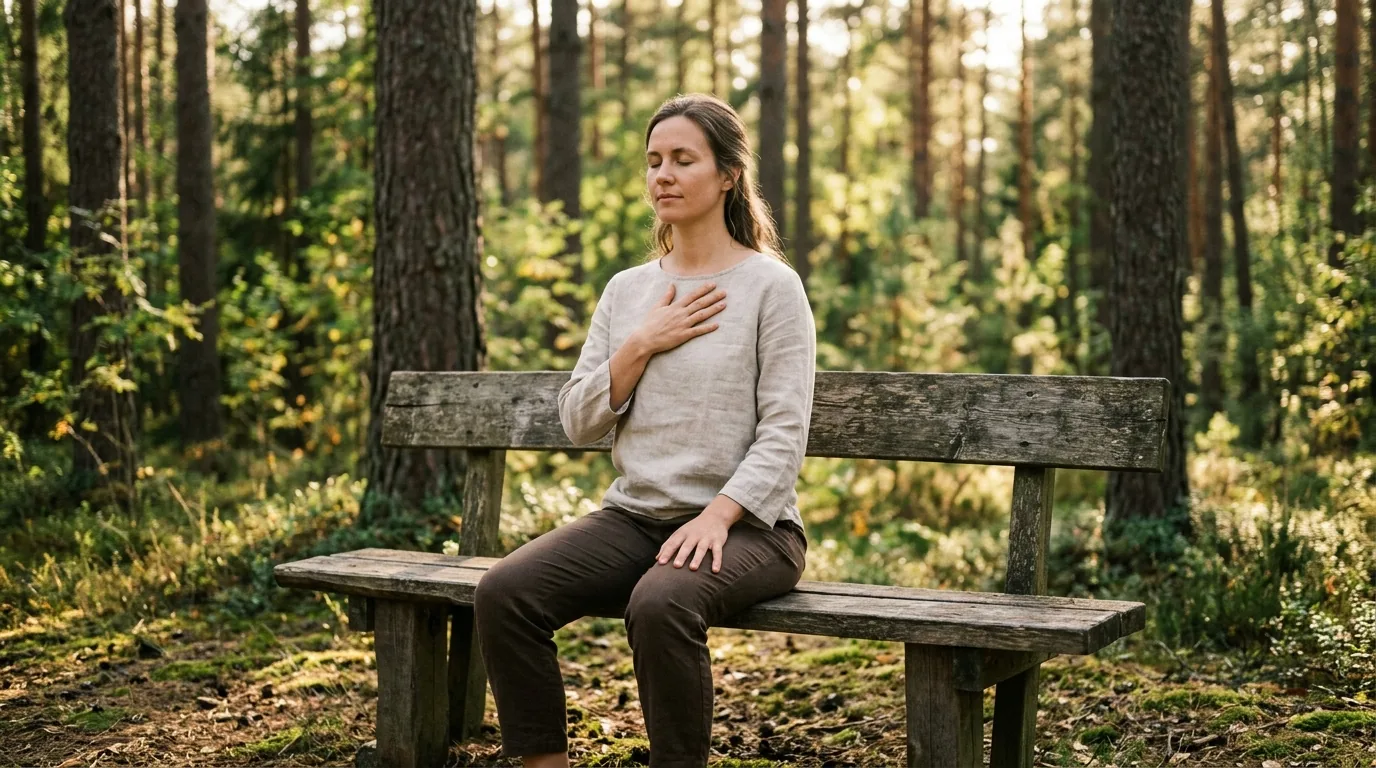
One hand on your chest, one on your belly. Breathe so that only the lower hand moves. Slow, no counting, five minutes.
If your anxiety lives mostly in your chest and shoulders, this is the one. It also doubles as a diagnostic: if the upper hand is doing all the moving, you have found the habit that is keeping the loop fed. It takes a few weeks to shift, and it does shift.
6. Extended exhale with a sound (for a racing heart)
Breathe in normally. Breathe out through slightly pursed lips with a quiet, steady ssss or a low hum, making the exhale as long as it will comfortably go.
The sound gives you feedback — you can hear the moment your exhale becomes ragged — and the resistance at your lips naturally slows it down. This is the most useful option when your heart is thumping and pure counting feels impossible.
Which One Should You Use?
| What is happening | Use this | For how long |
|---|---|---|
| Anxiety spiking fast, chest tight | Physiological sigh | 2-3 breaths |
| Steady background worry | 4-6 breath | 2-5 minutes |
| Need to be calm but alert | Box breathing | 3-4 minutes |
| Overthinking at night | 4-7-8 | 4 rounds |
| Heart racing | Extended exhale with sound | 1-2 minutes |
| Building a daily habit | Belly breathing | 5 minutes |
The Mistake That Makes People Give Up
Here is the ninety-second problem promised at the top. Most people, told to take a deep breath, take an enormous gulp of air into the top of the chest and then let it straight back out. Do that six times and you will feel light-headed, slightly panicky, and completely convinced that breathing exercises make anxiety worse.
They do, when done that way. Over-breathing changes your blood chemistry in a direction that produces tingling hands, dizziness and a sense of unreality — all of which your anxious brain will happily interpret as fresh evidence of catastrophe.
The fix is counter-intuitive: breathe less, not more. A calming breath is a small, quiet, unhurried inhale followed by a long exhale. If someone sitting next to you could hear you doing it, it is too big. Aim for a breath so undramatic that it would be invisible on camera.
What Gets Hard, and What to Do About It
You feel more anxious when you start
Turning attention toward your body is uncomfortable if your body is where the anxiety lives. This is common enough to have a name in therapy circles, and the workaround is to keep your eyes open, stay upright, and anchor half your attention outside yourself — the sound of traffic, the feel of the chair. If it still spikes, stop and walk instead. Motion is a legitimate alternative to stillness, and you can come back to the breath later.
You cannot make it to the end of the count
Then the count is too long. There is no prize for a six-count exhale. Shorten it until it is easy, practise at easy for a week, and it will lengthen without you deciding to.
You forget to do it exactly when you need it
Universal. A technique you have practised only in a crisis will not be available in a crisis. Practise it for two minutes a day when you are calm and bored — that is what makes it show up on its own when things go sideways.
Your mind wanders the whole time
Then it is working normally. Noticing you have wandered and returning to the count is the exercise, not an interruption of it. If wandering bothers you, our guide to meditation for beginners covers what to do with a busy mind in more depth.
It works, but only for ten minutes
That is a reasonable result, not a failure. Ten calm minutes is often exactly the gap you need to make one decision, send one message, or fall asleep. Longer-lasting change comes from the daily practice, not the emergency use.
If the anxiety is arriving as a full spiral rather than as a physical spike, a sensory technique often works better than a breathing one — the 5-4-3-2-1 grounding technique is the standard tool for that, and the two combine well.
If You Have a Diagnosed Anxiety Disorder
Worth being clear, because the wellness internet often is not. A diagnosed anxiety disorder — generalised anxiety, panic disorder, social anxiety — is a clinical condition with established treatments, and breathing exercises are not one of them on their own. They sit alongside therapy and, where appropriate, medication, as something you can do between sessions and in the moments treatment cannot reach.
Used that way they earn their place. Breath work is frequently taught inside cognitive behavioural therapy for panic, precisely because it gives you something concrete to do with your hands and lungs while the harder cognitive work is going on. But if breathing exercises are the only thing standing between you and a bad week, that is a signal to talk to a doctor or therapist, not to breathe harder.
One practical note: if you have a respiratory or cardiac condition, are pregnant, or have a history of fainting, skip the breath-holding techniques (box breathing, 4-7-8) and stick to the simple extended exhale unless a clinician has told you otherwise.
Building a Practice That Survives a Bad Week
Two minutes a day, attached to something you already do without thinking. After you brush your teeth. Before you start the car. While the kettle boils. The anchor matters more than the time of day, because a bad week will erase a clock time and leave the kettle exactly where it was.
Skip the streak counting. A streak turns one missed day into a reason to quit, and consistency over months is what changes your resting baseline — not an unbroken chain. Practise most days, and if you disappear for a month, come back with two minutes rather than a plan to make up for it.
When two minutes has become genuinely automatic and you want more, the natural next step is adding stillness rather than more breathing — a short body scan meditation after your breathing, or a look at how long you should meditate before you commit to a longer sit.
What to Expect, Week by Week
Week one: it feels mechanical and slightly silly. You will notice, maybe once, that you feel calmer afterwards, and you will not be sure whether that counts.
Weeks two to three: the technique starts arriving on its own — usually in a mild moment, like traffic, rather than a big one. This is the important milestone, even though it feels small.
Weeks four to eight: you catch anxiety earlier. Not less often, necessarily, but sooner, while it is still small enough to do something about.
Beyond: for many people the background hum quiets a little. Not gone. Quieter, and less alarming when it does turn up, which frankly is most of what anyone wants.
Breath is only one of the levers available. For the others — orienting, humming, shaking, weighted contact — see somatic exercises for anxiety.
For most people, breathing in for four and out for six is the best starting point. The longer exhale slows the heart rate, and the counting occupies the mind. Two minutes is enough to feel a difference. Use the physiological sigh instead when anxiety spikes suddenly and you only have a few seconds.
The immediate calming effect usually appears within sixty to ninety seconds of slow breathing. Lasting change in your baseline anxiety takes longer — most people notice a difference after two to four weeks of practising a couple of minutes most days.
They can, temporarily, in two situations: if you breathe too deeply and too fast, which causes light-headedness, or if turning attention toward your body makes you more aware of anxious sensations. Both have fixes — breathe smaller and quieter, keep your eyes open, and anchor part of your attention outside yourself.
They can shorten a panic attack and give you something to do while it passes, and breath work is often taught as part of therapy for panic. Avoid breath-holding techniques during an attack; use a simple long exhale instead. Breathing exercises are a support alongside treatment, not a replacement for it.
One deliberate session of two to five minutes a day, plus using a technique whenever you need it. More than that offers little extra benefit, and a short daily practice is what makes the technique available automatically when anxiety actually arrives.
Start With Two Minutes
Not tomorrow, and not after you have chosen the optimal technique. Right now, wherever you are reading this: in for four, out for six, six times. That is under a minute.
It will not fix anything permanently, and it is not supposed to. What it does is prove to you that the brake pedal exists and that you know where it is — and on the day you actually need it, that is the only thing that matters. When you are ready for something longer and quieter, sleep meditation is a natural next stop.
Keep reading
How to Stop Focusing on Your Breathing During Meditation
How to Stop Focusing on Your Breathing During Meditation Knowing how to stop focusing on your breathing is one…
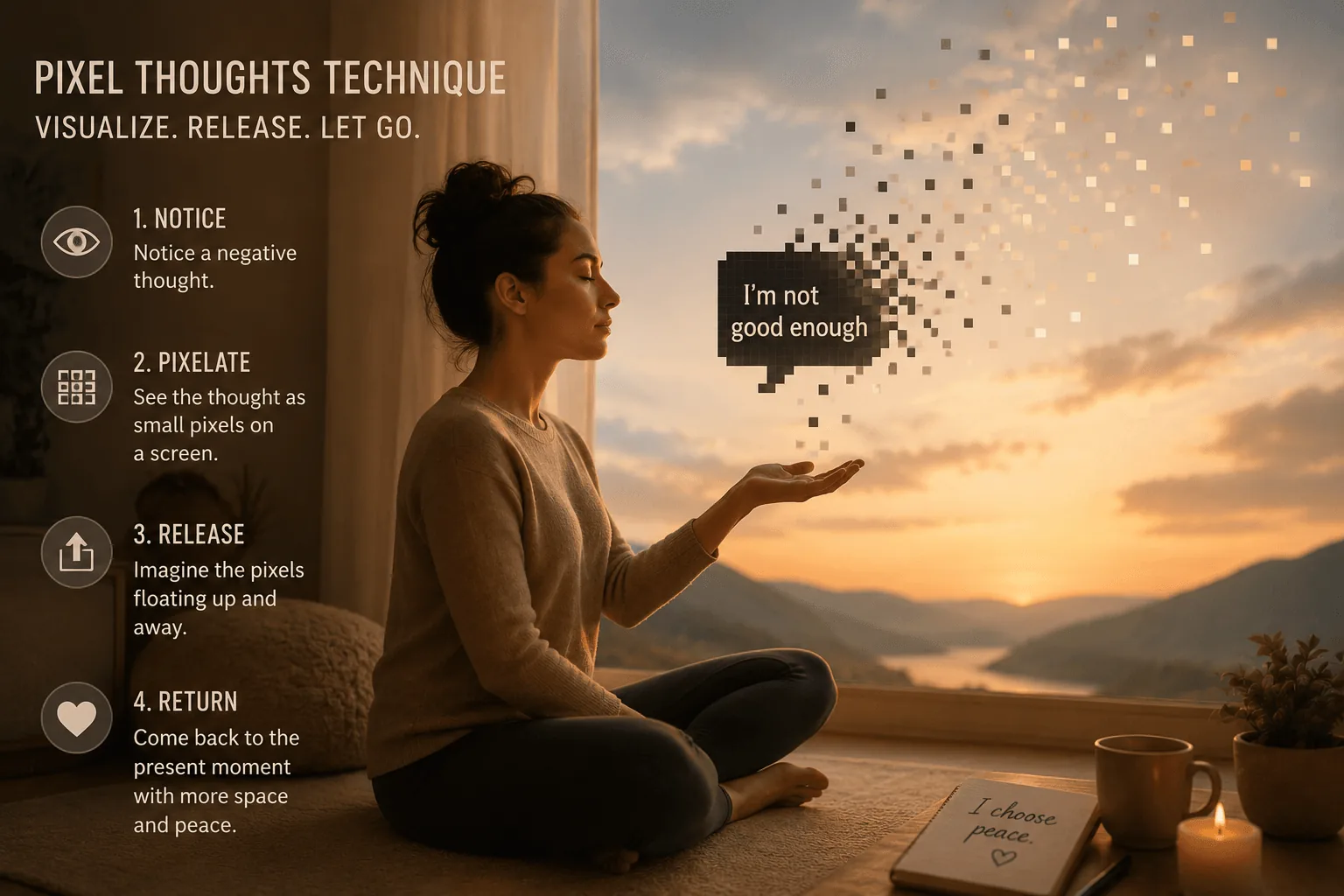
Pixel Thoughts: Let Go of Negative Thoughts With Mindfulness
Pixel Thoughts: How to Let Go of Negative Thoughts and Calm Anxiety Pixel thoughts is a mindfulness-based visualization…
STOP Method: The Mindfulness Technique That Resets Your Mind
The STOP method is a four-step mindfulness intervention designed to interrupt automatic stress responses and return you…