Breathing Ball: Benefits, Techniques & Exercises for Kids
Breathing Ball: Benefits, Techniques & Exercises for Kids
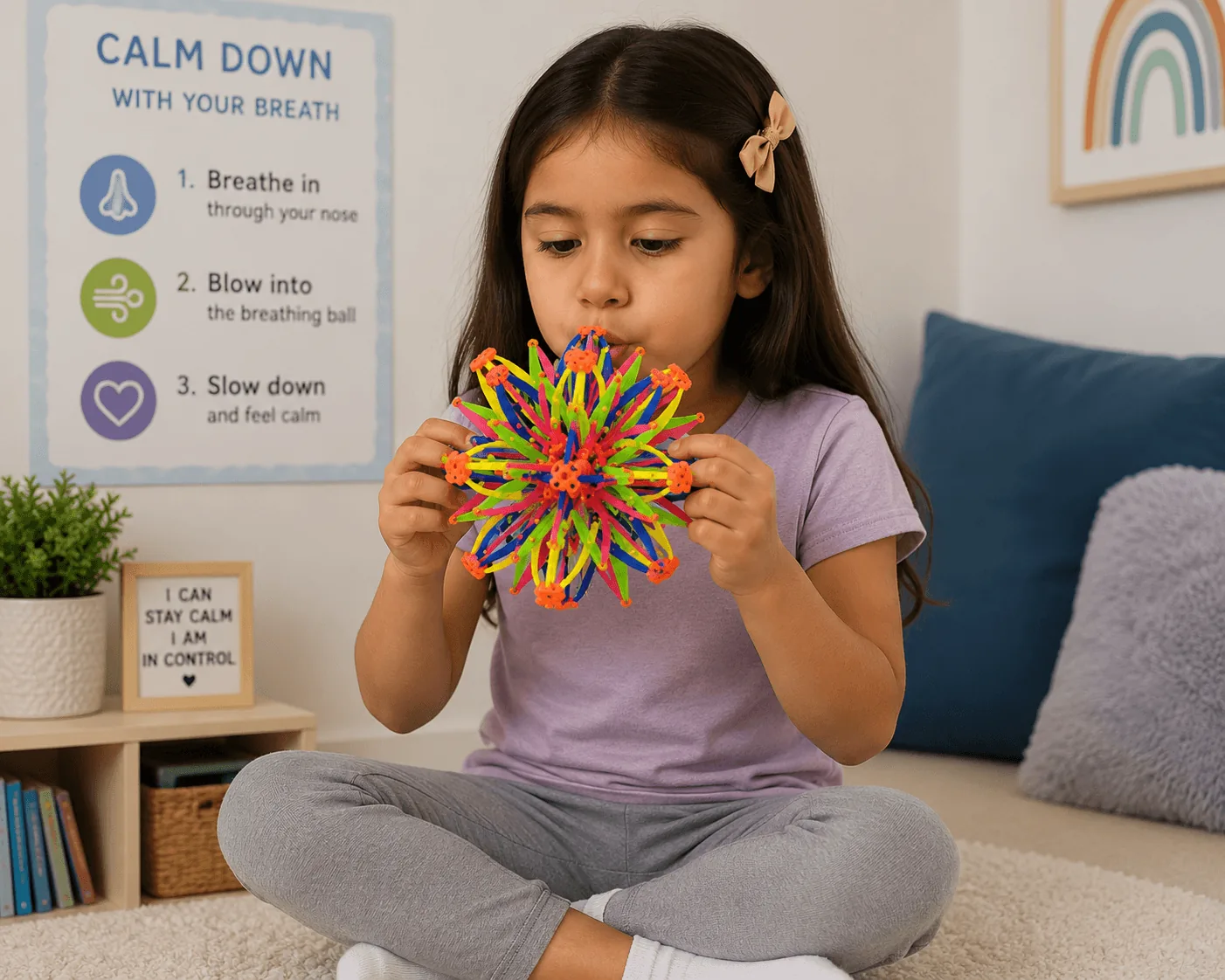
A breathing ball is one of the most effective, science-backed tools for teaching breath control — and it works for both children and adults. Originally popularized in occupational therapy and mindfulness-based stress reduction (MBSR) programs, the breathing ball gives users a tactile, visual anchor to pace their inhales and exhales. Whether you’re managing anxiety, helping a child regulate their emotions, or adding a new tool to your wellness practice, understanding how to use a breathing ball correctly makes all the difference.
What Is a Breathing Ball?
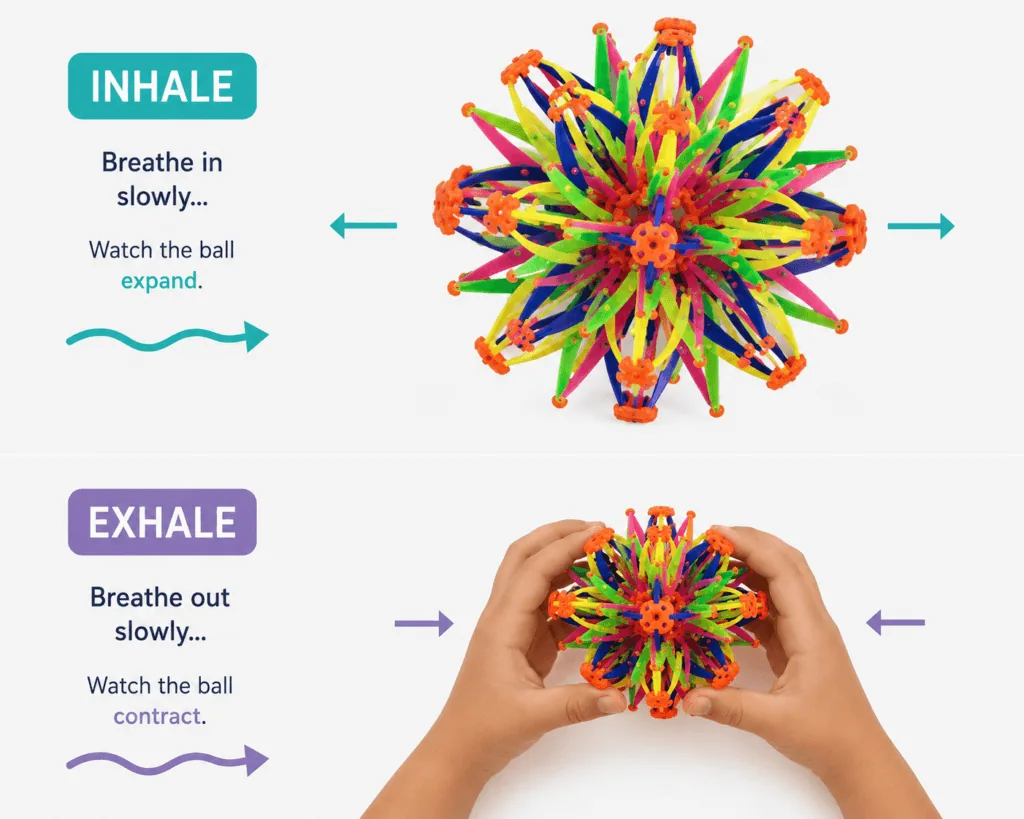
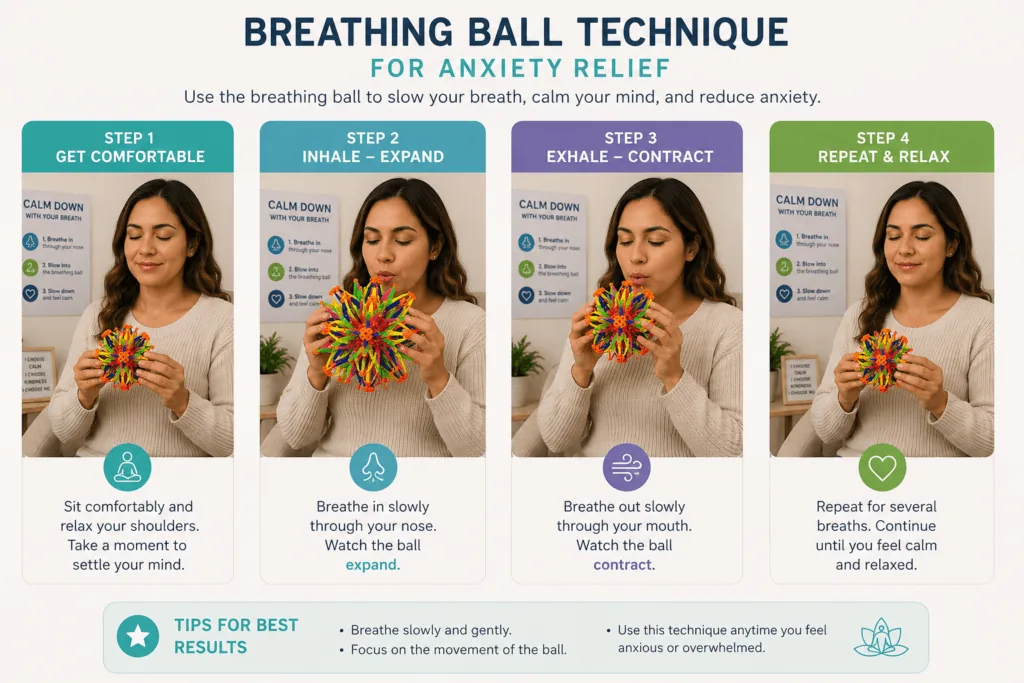
A breathing ball — sometimes called a hoberman sphere or expand-and-breathe ball — is a collapsible, latticed sphere that expands and contracts with physical manipulation. When you open the ball, you inhale. When you close it, you exhale. This synchronized movement creates a powerful biofeedback loop: your body learns to match breath rhythm to physical motion.
Unlike phone apps or audio guides, the breathing ball is tangible. That physicality is its core advantage, particularly for young children or anyone who struggles with abstract mindfulness instructions.
The Science Behind It
Slow breathing at around five or six breaths a minute is the pace that settles the body most reliably. The breathing ball works because it makes that pace visible instead of something a child has to count.
Occupational therapists frequently use breathing balls as sensory tools because they combine proprioceptive input (the physical resistance of the ball) with respiratory regulation. That dual engagement is especially effective for children with ADHD, autism spectrum disorder, or anxiety.
Benefits of Using a Breathing Ball
For Adults
- Reduces acute stress — A 2-minute breathing exercise with a ball can lower perceived stress faster than unguided breathing.
- Improves focus — Paced breathing before cognitively demanding tasks improves working memory and attention.
- Supports sleep onset — Using a breathing ball before bed slows the nervous system and signals the brain to prepare for sleep.
- Accessible mindfulness — Ideal for people who find meditation abstract or difficult to maintain without a physical prompt.
For Children
- Teaches emotional regulation early — Children as young as 3 can use a breathing ball with guidance.
- Non-verbal coping tool — During tantrums or meltdowns, verbal instruction often fails. A breathing ball gives kids something to do with their hands.
- Classroom-ready — Low-disruption, silent, and portable. Many teachers keep one at their desk for individual students who need a reset.
- Fun and engaging — The sphere’s visual movement keeps children interested longer than standard breathing cues.
Pros and Cons at a Glance
| Pros | Cons |
|---|---|
| Tactile and visual — easy to follow | Requires physical handling (not ideal for all sensory profiles) |
| No screen, no app, no subscription | Can be lost or damaged (especially with younger children) |
| Works across age groups | Some users prefer audio-only guidance |
| Clinically used in therapy settings | Not a standalone treatment for clinical anxiety disorders |
Breathing Exercises for Kids: Step-by-Step Guide
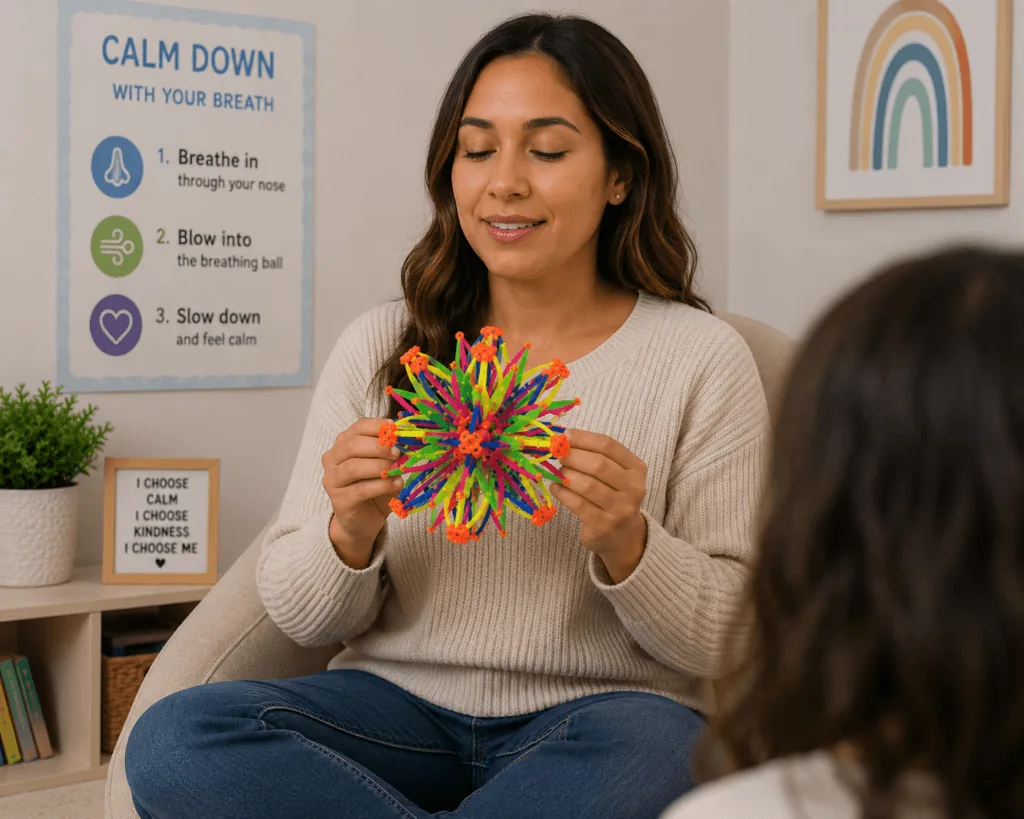
These breathing exercises for kids are designed to be simple, engaging, and repeatable without adult supervision once learned.
1. The Basic Expand-and-Breathe
Best for: Ages 3–10, first-time users
Steps:
- Hold the breathing ball with both hands.
- Open the ball slowly as you inhale through your nose for 4 counts.
- Pause for 1 count at full expansion.
- Close the ball slowly as you exhale through your mouth for 4 counts.
- Repeat 5–10 times.
Tip: Use a count of “1 Mississippi, 2 Mississippi” to naturally slow the pace without a timer.
2. Box Breathing with the Ball
Best for: Older children (ages 8+), teens, and adults managing anxiety
Box breathing is a technique used by Navy SEALs and clinical psychologists alike. Adding the ball makes it concrete.
Steps:
- Open the ball — inhale for 4 counts.
- Hold the ball open — hold breath for 4 counts.
- Close the ball — exhale for 4 counts.
- Hold the ball closed — hold for 4 counts.
- Repeat 4–6 rounds.
3. 4-7-8 Breathing
Best for: Sleep support, high anxiety moments
This technique, developed by Dr. Andrew Weil, is particularly effective for calming the nervous system before sleep.
Steps:
- Open the ball — inhale for 4 counts.
- Hold still — hold for 7 counts.
- Close the ball — exhale for 8 counts.
- Repeat 4 times.
Note: The extended exhale is key. Longer exhales activate the vagus nerve, triggering the relaxation response.
4. Belly Breathing Buddy
Best for: Ages 2–6, sensory learners
This variation turns the breathing ball into a storytelling prop.
Steps:
- Name the ball — children often respond better to a named object (“This is Breathe Bear”).
- Tell the child the ball needs help breathing in and out.
- Guide them: “Help Breathe Bear take a big breath in” — open the ball.
- “Now help Breathe Bear breathe out slowly” — close the ball.
- Repeat 5 times.
This reframe shifts the emotional load away from the child, which is particularly effective for anxious or resistant kids.
How to Choose the Right Breathing Ball
Not all breathing balls are equal. Here’s what to look for:
- Size: For young children, a ball that opens to about 12–14 inches is ideal. Adults typically prefer a 20–24 inch expansion range.
- Resistance: Light resistance keeps breathing natural and non-effortful. Avoid very stiff models for young users.
- Material: Look for BPA-free, non-toxic plastic. Some models now use silicone-coated rods for durability.
- Color: Bright, contrasting colors help children track the movement visually, which enhances the biofeedback effect.
Expert Perspective
Dr. Patricia Gerbarg, a psychiatrist at New York Medical College and co-author of The Healing Power of the Breath, has documented how breath-work tools that give patients a visual or tactile anchor dramatically improve compliance and outcomes compared to instruction-only approaches. The principle applies directly to breathing tools like the breathing ball: when the breath has something to follow, the mind follows too.
Occupational therapists working in sensory integration therapy have incorporated breathing balls into “calm-down kits” for over a decade. The consensus is clear — tools that engage multiple senses simultaneously (touch, sight, proprioception) are more effective than single-modality cues for children with regulatory challenges.
The breathing ball is a deceptively simple tool with serious clinical credibility. Whether you’re introducing breathing exercises for kids at home, supporting a child’s emotional regulation at school, or managing your own stress, the breathing ball offers a structured, evidence-informed path to calmer breathing. The key is consistency — even five minutes of daily practice produces measurable results within two weeks. Start with the basic expand-and-breathe technique, build toward box breathing, and let the ball do what it does best: give your breath somewhere to go.
What Works at Which Age
The breathing ball is often sold as a universal calming tool, and it is not — it is excellent for a fairly specific age range and needs adapting either side of it.
| Age | What to expect | How to use it |
|---|---|---|
| 2-3 | Wants to play with it, not breathe with it | Let them. Open and close it yourself nearby and breathe out loud |
| 4-6 | The sweet spot — the visual instruction lands | Three to five breaths, adult breathing alongside them |
| 7-9 | Works well, may want to hold it themselves | Let them set the pace; you follow their ball |
| 10-12 | May find it babyish in front of others | Keep it for home; teach the hand version for school |
| Teens and adults | Surprisingly effective, rarely admitted to | Use privately, or as a shared family object |
The general rule: the younger the child, the more the adult does and the less is asked of them. A three-year-old watching you breathe slowly with the ball is getting most of the benefit, because a calm adult is doing more regulating than any object.
What Gets Hard, and What to Do About It
They refuse to use it when upset
The most common problem, and it has a clear cause: a tool introduced during a meltdown becomes part of the meltdown. Introduce it exclusively when everyone is calm and nothing is wrong — as a game, several times, over a couple of weeks. Only once it is thoroughly boring and familiar will it be available when things go badly.
They breathe too fast to match it
Do not correct them. Start the ball at their speed, however fast, and slow it down gradually over five or six breaths. Matching first and leading second works; instructing a distressed child to breathe slower almost never does.
They get dizzy
Usually a sign of breathing too deeply rather than too slowly. Make the in-breath smaller and quieter and let the out-breath be the long part. A calming breath should be almost undetectable to anyone watching.
It works once and then stops working
Novelty was doing some of the early work. Put it away for a fortnight and bring it back, or move it to a fixed moment — before homework, after school, at bedtime — so it becomes a routine rather than an event.
You do not have a breathing ball
Then use your hands: fingertips together, open them slowly like a flower on the in-breath, close them more slowly on the out. It travels everywhere, costs nothing, and works for older children who have decided the ball is for little kids. Adults can use the same thing under a desk in a meeting, which is a considerably better secret than it sounds.
For the wider set of practices children take to — and the age-by-age version of what is realistic — see mindfulness for kids.
Why It Works for Adults Too
Worth saying, because the breathing ball is filed under children's tools and it is genuinely useful to anybody.
The reason is that it removes the counting. Most calming breath techniques ask you to track numbers in your head at exactly the moment your head is least cooperative. The ball replaces that with something you can simply follow with your eyes, which requires almost nothing of a mind that is already busy panicking.
That is the same principle behind every good technique in our breathing exercises guide: the fewer instructions a method requires, the more likely it is to be available when it matters.
What to Expect
First few uses: a novelty toy. Expect play, not practice, and let that happen — the association you are building is that this object is pleasant and unthreatening.
After a week or two: the child will use it when calm and prompted. This is the real milestone, even though it looks like nothing.
After a month: some children will go and get it themselves when upset. Not all will, and the ones who do not are still absorbing the slower breathing they have watched you do.
Long term: the ball becomes unnecessary and the hand version, or just the longer exhale, remains. That is the goal — the object was always a set of training wheels.
It works best between about four and nine, where the visual instruction is easy to follow. Younger children mainly benefit from watching a calm adult use it, and older children often prefer a discreet hand version they can use without being seen.
Introduce it only when everyone is calm, as a game, repeatedly over a couple of weeks. A tool first offered during a meltdown becomes part of the meltdown. Once it is familiar and slightly boring, it becomes available in a difficult moment.
Three to five is plenty. Start at the child's own pace, however fast, and slow the ball down gradually over those breaths. Matching first and leading second works far better than asking a distressed child to breathe slowly.
Yes, and it works well. Its advantage is that it removes counting — you simply follow the movement with your eyes, which asks almost nothing of a mind that is already overloaded. The hand version does the same job discreetly.
Your hands: fingertips together, opening slowly like a flower on the in-breath and closing more slowly on the out-breath. It costs nothing, goes everywhere, and suits older children who have decided the ball is for younger ones.
FAQ
Q1: What is a breathing ball used for? A breathing ball is used to guide controlled, paced breathing. By physically expanding and contracting the ball in sync with inhales and exhales, users engage both their body and breath, which helps reduce stress, manage anxiety, and improve emotional regulation. It is widely used in schools, therapy settings, and home wellness routines.
Q2: Are breathing balls effective for children with anxiety? Yes. Breathing balls are particularly effective for children with anxiety because they provide a tactile and visual anchor that makes abstract breathing instructions concrete. Multiple occupational therapists and child psychologists incorporate them into sensory regulation and calm-down protocols. They are appropriate for children as young as 3 years old with adult guidance.
Q3: How long should a child use a breathing ball during each session? Most therapists recommend 2–5 minutes per session for younger children (ages 3–7) and up to 10 minutes for older children and adults. Shorter, consistent daily sessions are more effective than long, infrequent ones. Even three to five slow breathing cycles can noticeably reduce heart rate and perceived stress.
Q4: Can adults use a breathing ball for stress relief? Absolutely. Adults benefit from breathing balls in the same way children do — the tactile feedback helps prevent mind-wandering that often derails unsupported meditation. Techniques like box breathing and 4-7-8 breathing are well-suited to adult stress management, performance preparation, and sleep support.
Q5: What is the difference between a breathing ball and a hoberman sphere? A hoberman sphere is the mechanical invention (patented by Chuck Hoberman in 1990) that forms the structural basis of most breathing balls. When marketed specifically for breathwork and mindfulness, the hoberman sphere is rebranded as a breathing ball and often comes with guided breathing instructions. Functionally, they are the same object — the difference is context and intended use.
Keep reading
Breathing Exercises for Anxiety: 6 Techniques That Work
Six techniques, when to use each one, and the common mistake that makes people feel worse instead of calmer.
Body Scan Meditation for Sleep: A Step-by-Step Guide
The full sequence, feet-to-head versus head-to-feet, how long it should take, and why falling asleep halfway through is fine.

Self-Compassion: How to Stop Being So Hard on Yourself
Seven practices, why the fear that it will make you lazy is backwards, and what to do when you actually did something wrong.